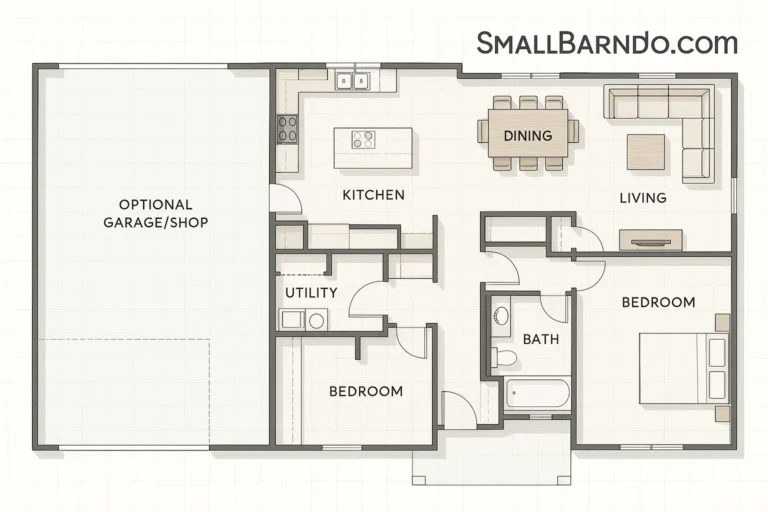
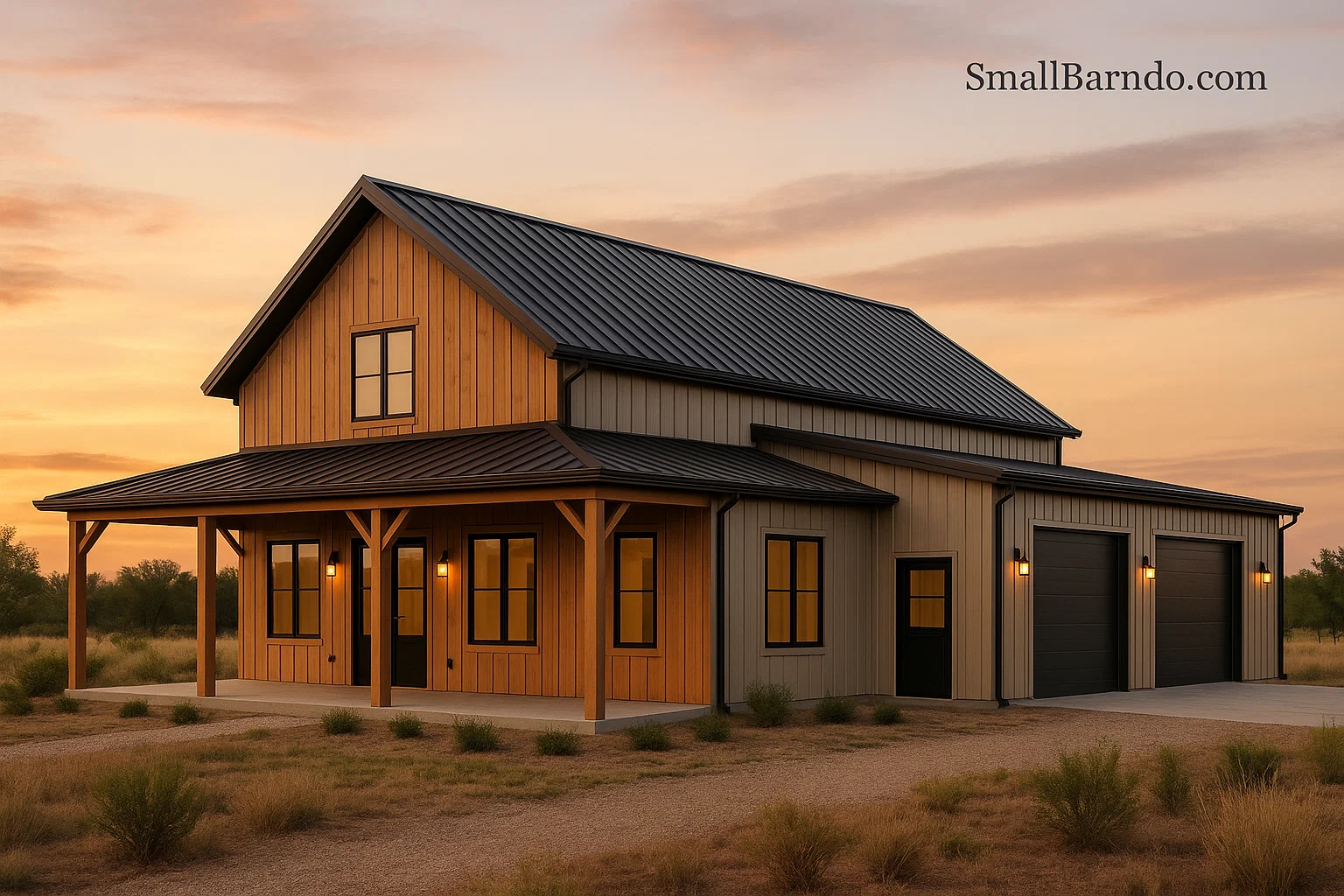
20 Superior Barndominium Plans with Shop and Attached Garage (Full Blueprints)
The yearning for a home that seamlessly blends living and working, comfort and capability, is a deep-seated American dream. You’re the one who understands that “home” shouldn’t mean sacrificing your passions, your business, or your need for expansive, functional space. Maybe you need a dedicated space for classic car restoration, a woodworking studio, or simply a massive, climate-controlled storage area for your RV and heavy equipment. You’re not just looking for a house; you’re looking for a compound, a place where your ambition can thrive right alongside your family life. Barndominium plans with shop and attached garage offer this perfect synergy, delivering the ultimate flexible property solution.
I know the frustration. I remember staring at endless traditional floor plans, trying to balance my need for a spacious three-bedroom layout with a garage bay large enough to actually work in a bay with high clearance, durable flooring, and ample power. The traditional stick-built home just couldn’t deliver without becoming prohibitively expensive. But the barndo? It’s the ultimate solution for those who refuse to compromise.
This article is your indispensable starting point. We’ve compiled a comprehensive guide to 20 superior barndominium plans with shop and attached garage, complete with detailed insights into the structural, mechanical, and code-related aspects of their blueprints. Your goal is to transition from a dreamer scrolling through Pinterest to a doer breaking ground on the property that finally matches your ambition. We will equip you with the knowledge to make informed decisions, ensuring your new structure is both compliant and perfectly tailored to your needs.
Table of Contents
Understanding the Barndominium Advantage: Why the Shop/Garage Combo Works
A barndominium, or “barndo,” is a metal or pole barn structure that has been partially converted into a residential living space. This definition is critical to understanding its architectural and financial benefits. The core appeal of the barndominium lies in its structural simplicity, which directly translates to its exceptional versatility and cost-efficiency, especially when integrating a large shop or attached garage.
The Cost-Effectiveness of Steel Frame Construction
When you compare building a traditional home to constructing a steel-frame barndo, the financial differences are significant. The core advantage stems from the use of prefabricated, durable steel kits, which streamlines the construction process dramatically.
- Cost Comparison (2025 Benchmarks):
- Traditional Stick-Built House: Expect costs ranging from $150 to $400 per square foot for full construction, largely due to intensive, on-site labor and material complexity.
- Steel-Frame Barndominium: The cost to build a full, finished barndominium typically ranges from $60 to $160 per square foot. The shell and kit alone can be as low as $20 to $35 per square foot.
The savings are a product of several factors: the materials are less susceptible to market volatility than lumber, the shell goes up in a fraction of the time, and the open-span nature eliminates the need for many load-bearing internal walls, reducing overall material and labor hours.
Integrated Living vs. Separate Structures
When you choose barndominium plans with shop, you’re selecting a superior, integrated approach over the traditional separation of home and workspace.
- Comparison: Barndominium (Integrated) vs. Traditional Home + Pole Barn (Separate)
| Feature | Integrated Barndominium with Shop | Traditional Home + Pole Barn/Separate Garage |
| Convenience & Access | Direct access via fire-rated transition door/mudroom. Seamless, weather-protected move between spaces. | Requires walking outside, reduced security, and exposure to the elements. |
| Shared Utilities | Centralized HVAC and plumbing can be shared (though often separated for air quality), reducing overall utility run lengths. | Separate utility lines, water, and gas runs are often required, increasing upfront cost. |
| Construction Timeline | Simultaneous construction of the entire structure under a single general contractor and permit. | Staggered permits and separate construction teams often required, extending project duration. |
| Resale Value | Valued as a cohesive, unique property style (often called a “shouse”) which can command a premium in rural/hobbyist markets. | Two separate appraisals may be required, and the pole barn is often valued less than integrated square footage. |
Limitation: A critical exception to this convenience is zoning. Before you finalize your blueprints, you must verify local zoning ordinances. Residential zoning may impose strict limits on the percentage or square footage of a home that can be classified as a non-residential shop, especially if you plan to run a commercial business from it.
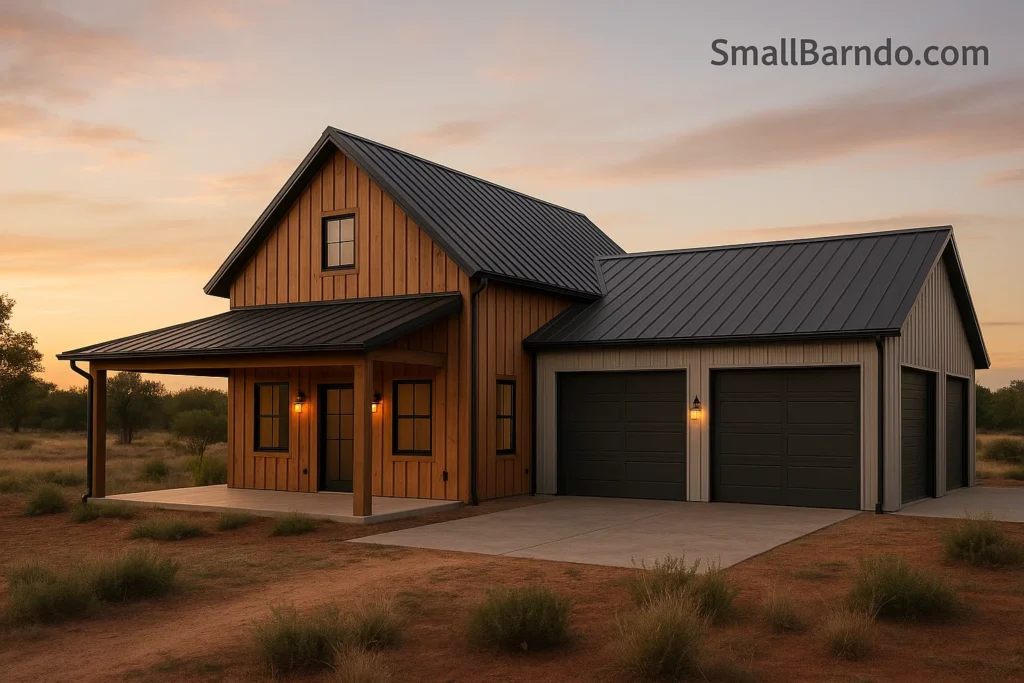
The Core Collection: 20 Superior Barndominium Plans with Shop
To help you navigate the vast array of available blueprints, we categorize the top barndominium plans with shop based on the primary function the structure is designed to serve. These designs represent the highest standard of efficiency, aesthetic appeal, and structural integrity.
Category 1: Plans for the Serious Hobbyist (The ‘Man Cave’ Barndos)
These plans prioritize the shop and garage space, often allocating $60\%$ to $75\%$ of the total square footage to the non-living areas. They are optimized for function over sheer residential size.
- Featured Plan Example: The ‘Titan 60×80’
- Features: This colossal plan often encompasses $4,800$ sq. ft. of dedicated shop space, leaving $1,800$ sq. ft. for an efficient, well-appointed loft apartment above or alongside the shop.
- Shop Specifications: Includes $14$-foot or $16$-foot overhead door clearances, necessary for RVs, fifth-wheel campers, or two-post vehicle lifts.
- Key Feature Highlight: Blueprints must include notation for separate ventilation critical for welding, auto-body work, or extensive woodworking, often requiring high-CFM exhaust systems and dedicated air makeup units to maintain air quality and residential safety.
Category 2: Family-Centric Designs with Functional Space
This category targets the typical family that needs a beautiful, spacious home and a large, attached garage/shop for personal projects, storage, or business inventory. The residential space dominates, typically representing $60\%$ to $75\%$ of the footprint.
- Featured Plan Example: The ‘Homestead 40×75.’
- Features: Offers $2,800$ sq. ft. of comfortable living space with $3$ bedrooms and $2.5$ baths, complemented by a $1,200$ sq. ft., $3$-bay attached garage.
- Comparison: This represents a $70/30$ split (living/shop), contrasting sharply with the $30/70$ split of the ‘Titan’ plan. This balance makes the property easier to finance through conventional residential lenders.
- Aesthetic Focus: These plans often feature expansive wraparound porches and decorative exterior finishes (e.g., stone wainscoting) to soften the industrial look of the metal structure, ensuring high curb appeal.
Category 3: Loft and Second-Story Shop Access Plans
These designs maximize natural light and views by placing the main residential living space (or a large portion of it) on a second story, with the entire ground floor dedicated to the shop, garage, and utility rooms.
- Design Advantage: Placing the living area on the upper level offers the best views and isolates living areas from the primary noise and dust sources of the shop below.
- Key Consideration/Exception: Structural Engineering is Non-Negotiable. The blueprints for this type of plan must specify robust structural supports, as the second-story floor assembly is carrying the full weight of the residential area (live load of furniture, people, etc.) across the wide spans of the ground-floor shop. You will need special engineering for the floor load capacity to ensure long-term safety.
Essential Blueprint Considerations for an Attached Shop
The full blueprints for any effective barndominium plan with a shop must detail several critical elements that go beyond standard residential construction. These are the elements that ensure safety, regulatory compliance, and maximum functionality for your dual-purpose structure.
1. Structural Integrity and Fire Separation
The wall separating your home from your shop is not merely a partition; it is a fundamental safety barrier.
- Firewall Requirements (IRC Compliance):
- According to the International Residential Code (IRC R302.6), a garage (or attached shop) must be separated from the residence and attics by no less than 1/2-inch gypsum board applied to the garage side.
- If you have habitable rooms above the garage/shop (a common feature in barndos), the separation requires a more robust material: not less than 5/8-inch Type X gypsum board or equivalent. This specialized drywall provides a $1$-hour fire resistance rating.
- Doors: Any openings in this wall (e.g., the door from the mudroom to the shop) must be protected by a solid wood door not less than $1-3/8 inches thick, or a $20$-minute fire-rated door, and ideally should be self-closing.
- Proper Shop Floor Load and Slab Specs:
- Your shop floor will handle much heavier static and dynamic loads than a simple garage. The blueprints must specify a reinforced concrete slab capable of supporting that weight.
- Recommended Concrete Specs:
- Thickness: While a residential slab may use $4 inches, a shop floor should be a minimum of $5 to 6 inches thick. For areas supporting a car lift, heavy equipment, or industrial use, $6 to 8 inches is strongly recommended.
- Strength: Use at least $4,000 PSI concrete mix. This is the most common choice, balancing strength and cost. Using $5,000+ PSI}$ concrete is advisable for commercial-grade machine shops or very heavy static loads.
- Reinforcement: The slab must be reinforced with rebar (e.g., $\#4$ rebar on a $12-inch}$ grid pattern) and/or welded wire mesh to manage load distribution and control cracking.
2. HVAC and Ventilation Systems
The air quality in your home cannot be compromised by the activities in your shop.
- Requirement: Separate HVAC Systems: It is a best practice and often a local code requirement to install two entirely separate heating, ventilation, and air conditioning (HVAC) systems. This prevents the circulation of dust, chemical fumes, and odors from the shop area into the residential living space.
- Shop Ventilation: Blueprints should include specifications for high-CFM exhaust fans (Cubic Feet per Minute) to rapidly exchange air. If your shop involves welding, painting, or heavy solvent use, you will need a dedicated industrial-grade ventilation system, which includes a method for replacing the exhausted air (air makeup unit).
3. Electrical Service and Power Distribution
A hobbyist or business-owner’s shop consumes significantly more power than a typical garage.
- Service Upgrade: A standard residential home typically requires a $200$-amp electrical service. A barndominium with a shop may necessitate a $300 to } $400-amp}$ service to handle the heavy demands of commercial equipment.
- Shop Requirements: Your blueprints must clearly denote the location and specifications for:
- Dedicated $240 {V}$ outlets for welders, air compressors, and heavy machinery.
- Adequate general $120V}$ outlets spaced according to code and utility.
- A dedicated sub-panel located within the shop for easy access and circuit separation from the main house panel.
Optimizing Your Barndominium Floor Plan for Dual Functionality
The genius of barndominium plans with shop is in the seamless integration of two disparate functions. The design shouldn’t feel like two buildings awkwardly mashed together, but rather a cohesive unit where work and life flow naturally.
- The Mudroom/Utility Buffer: This transitional space is the unsung hero of the barndominium floor plan. It should be a large, dedicated utility room located between the shop entrance and the main residential kitchen/living area.
- Purpose: It acts as a contamination zone to contain dirt, dust, and noise.
- Features to Include: A dedicated shower or sink (slop sink), robust flooring (concrete or tile), lockers for work clothes, and the main laundry facilities.
- Noise Mitigation Strategies: Sound travels easily through shared walls and structures. You must design proactively to ensure the roar of your air compressor doesn’t interrupt dinner.
- Placement: Place all Primary Bedrooms on the opposite side of the structure from the shop’s busiest areas or, ideally, on a second story (refer back to Category 3 designs). Use secondary rooms like pantries, closets, and utility rooms as sound buffers along the shared wall.
- Insulation: Specify closed-cell spray foam insulation in the shared wall and ceiling structures. Spray foam offers superior acoustic dampening compared to fiberglass batt insulation, creating a much quieter, more energy-efficient residential space.
- Shop Access and Driveway Flow: Consider the functional flow of vehicles and deliveries.
- A large shop often requires large trucks or heavy equipment access. Ensure the main overhead shop doors and their dedicated driveway approach do not detract from the residential curb appeal or conflict with the family’s daily vehicle traffic flow. Some premium barndominium plans with shop include a separate, dedicated access road specifically for the shop, especially for commercial operations.
The Final Step: Customization, Exceptions, and Limitations
While stock plans give you an excellent foundation, a true barndominium often requires some degree of customization to fit your lifestyle perfectly.
- Customization vs. Stock Plans:
- Stock Plans: Typically cost between $800 and $2,000 for a full set of downloadable blueprints (PDF or CAD files). These are fast and budget-friendly.
- Custom Plans: Can cost upwards of $4,500 to $6,000 or more but allow you to tailor load-bearing calculations, utility placement, and aesthetic choices precisely. Customizing a stock plan is often the most cost-effective path.
- Exceptions and Limitations on Use:
- Zoning (Revisited): This is the single biggest potential point of failure. If you plan to run a business (a commercial shop) from your attached structure, you must obtain a Conditional Use Permit (CUP) from your local municipality. Standard residential zoning may prohibit the operation of a full-scale commercial venture.
- Financing Conditions: Be aware that traditional lenders often prefer a residential-dominant structure. If your barndominium plan with a shop has a living-to-shop ratio lower than $50/50$, you may be forced to use specialized construction loans or financing typically reserved for commercial or agricultural properties, which can have different terms and interest rates.
FAQ: Answering Your Top Questions on Barndominium Plans with Shop
- Q: Do I need special financing for a barndominium with a shop?
- A: Yes, you often do. Most conventional lenders prefer to see a barndominium plan with a shop where the residential square footage is clearly greater than the shop/garage footage. If the shop is too large relative to the home, the property might be classified as mixed-use or commercial. You should specifically seek out construction loans that are comfortable with “flex-use” properties or those familiar with barndominium builds.
- Q: What is the ideal size for a comfortable living space in a barndominium with a shop?
- A: For a standard $3$-bedroom family, plans between $1,800$ and $2,500$ sq. ft. of residential living space are the most common and comfortable. The shop size should be determined by your specific needs, but adding at least $1,000 to 1,500 sq. ft. for the shop ensures it is truly functional rather than just an oversized garage.
- Q: What is the biggest advantage of a barndominium over a traditional home with a separate workshop?
- A: Beyond the cost savings, the key advantage is security and climate control. By integrating the shop into the primary structure, you secure your expensive tools, equipment, and projects behind the same envelope as your home, often utilizing the same (though separated) insulated structure, minimizing heat loss and pest intrusion.
Conclusion: From Blueprint to the Keys to Your Dream
Choosing one of the 20 superior barndominium plans with shop is the first giant step toward a life optimized for both leisure and labor. These unique structures offer the flexibility, durability, and cost-efficiency that modern, ambitious homeowners demand. By focusing on critical aspects like fire separation, proper utility design, and a functional flow between the shop and home, you move beyond the beautiful rendering and into the realm of practical, safe construction. The blueprints are ready to be utilized. The foundation is waiting to be poured.
Don’t let your dream of a perfect work-life integration remain a general idea. The time to plan is now.