30 Brilliant Container House Layouts for 40ft and Multi-Container Designs
Have you ever dreamt of a home that is truly your own, one that embodies freedom, sustainability, and smart design, without the staggering cost and environmental toll of traditional construction? Perhaps you’ve scrolled through endless images of minimalist tiny homes, feeling a pang of desire for a life less cluttered, yet worried about sacrificing precious space.
We understand that feeling. The transition to a smaller, more sustainable home shouldn’t mean compromising your comfort or your vision for the future. You deserve a space that feels expansive, regardless of its footprint. That’s why the world of container homes, particularly the versatile 40ft container house layouts and ambitious multi-container designs, is so revolutionary. They offer a blank, robust canvas, allowing you to build a custom sanctuary that is both eco-friendly and surprisingly spacious. This guide provides you with a blueprint 30 brilliant container house layouts that prove living big can absolutely happen inside a steel box.
Table of Contents
The Appeal of Container Living: Why Choose Steel?
Before diving into specific container house layouts, you should understand the core benefits that draw so many people to these corrugated steel structures. These benefits extend beyond simple novelty; they speak to durability, cost, and the environment.
- Sustainability: Your choice to build with a shipping container contributes to the “upcycling” movement. Considering the estimated 17 million unused shipping containers sitting idle globally, you are giving a second life to an immensely durable resource that would otherwise contribute to industrial waste.
- Durability and Speed: Built to withstand harsh ocean voyages, containers are inherently weather-resistant. Furthermore, the modular nature of containers can drastically reduce construction time, often 40–60% faster than traditional stick-built homes, because the core structure (the shell) is already complete.
- Cost-Effectiveness: While not always a guaranteed “cheap” house (as we will discuss later), the initial purchase of the shell is significantly lower than traditional framing materials. A used, cargo-worthy 40ft High Cube container typically costs between $3,400 and $5,500 at the time of this writing.
Section 1: The Versatile 40ft Container House Layouts (The Standard Bearer)
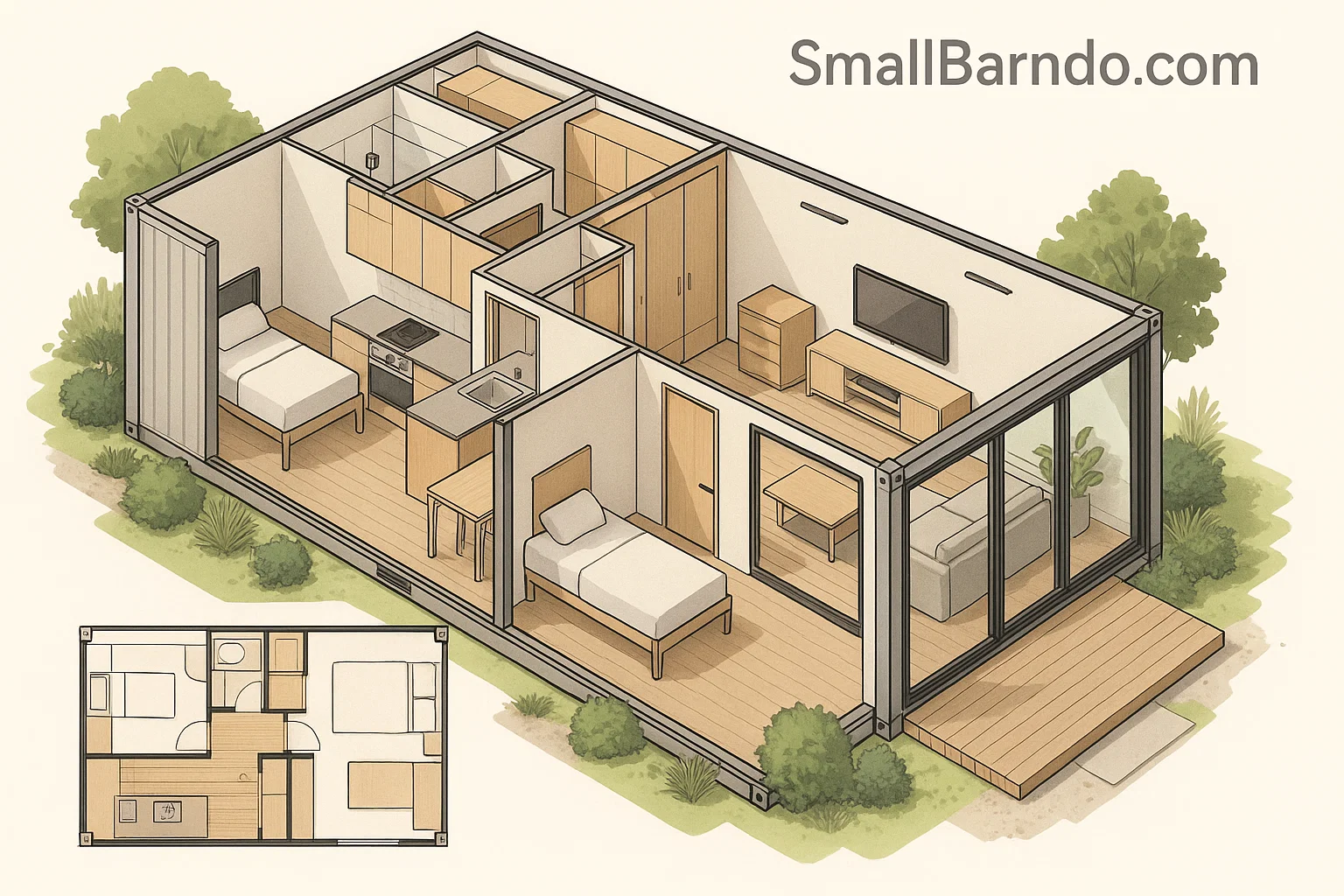
The 40ft High Cube container is arguably the most efficient and popular unit for a standalone dwelling. It provides approximately $320 sq ft of usable space, offering a functional balance between size and transportability. However, the $8\text{ ft}$ external width presents a challenge: after framing and insulation, your interior width will shrink to about $7\text{ ft} 4\text{ in}$. Clever layouts are essential to make this narrow space feel open.
Here are 10 unique 40ft container house layouts that maximize this linear space:
10 Creative 40ft Container House Layouts
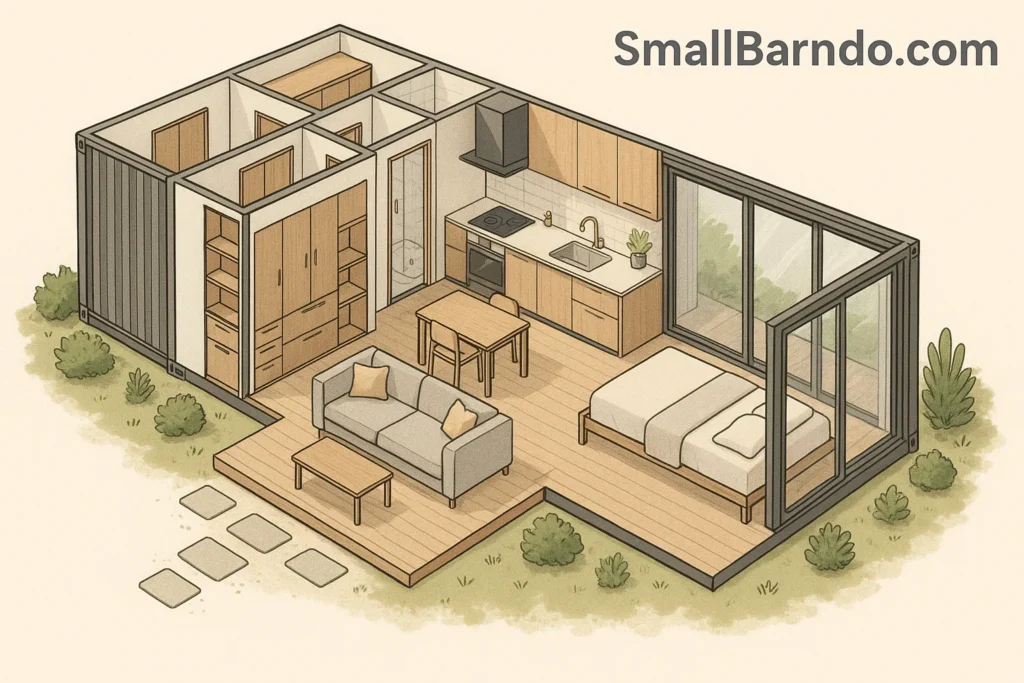
1. The Studio/Minimalist Layout
- Description: This design embraces the rectangular structure with an open-concept flow. Your living, sleeping, and cooking areas blend seamlessly.
- Key Feature: A compact, defined “wet core” (kitchenette and bathroom) is positioned at one end, simplifying plumbing runs. A Murphy bed or sofa bed is non-negotiable for daytime floor space.
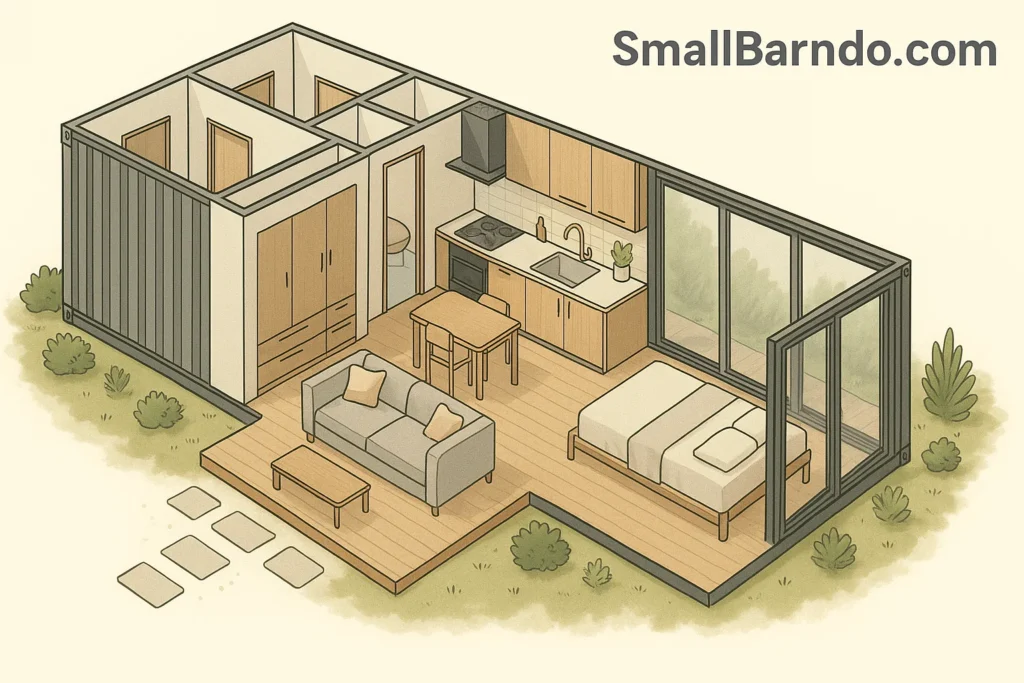
2. The One-Bedroom Layout with a Defined Living Area
- Description: You create privacy by installing a single partition wall near the end of the container to separate the bedroom.
- Key Feature: To avoid a cramped hallway, use pocket or sliding interior doors, which eliminate the swing radius of traditional doors.
3. The End-to-End Galley Kitchen Layout
- Description: The entire kitchen is built along one long wall, typically taking up about $12-15\text{ ft}$ of the length.
- Key Feature: This is perfect if you love cooking, as it reserves the opposite end for a spacious living area and the other for a private bedroom/bathroom.
4. The Split-Level/Loft Layout (High Cube Advantage)
- Description: By choosing a 9.5ft High Cube container, you gain an extra foot of height. You can utilize this to build a small loft or elevated sleeping area over the bathroom/storage.
- Key Feature: The loft adds architectural interest and maximizes the feeling of vertical space.
5. The Office/Flex Space Layout
- Description: Tailored for the remote worker, this plan dedicates one end of the container to a quiet, built-in office space or studio.
- Key Feature: A large picture window in the office area is critical to make it feel less like a box and more like an inspiring workspace.
- … The remaining five 40ft layouts include:
- 6. The Central Bathroom Core: Placing the bathroom/utility room in the center to naturally separate the living area from the bedroom.
- 7. The Two-Entrance Design: Ideal for a rental unit, placing an entrance at both ends for flow and exterior access.
- 8. The Covered Porch Integration: Cutting a section out of the end and recessing the door/window to create a small, sheltered entryway.
- 9. The Closet/Storage Wall Layout: Building a wall of floor-to-ceiling cabinetry along the entire length of one wall to solve all storage problems.
- 10. The Twin Sleeper Bunk Layout: Designed for a guest house, incorporating two sets of built-in bunks at one end.
Section 2: Multi-Container Designs (Going Big with Modularity)
When a single $320\text{ sq ft}$ unit isn’t enough, combining containers allows you to scale up to family-sized homes. This modular approach is where container house layouts truly shine, offering diverse configurations that mimic traditional architecture. Here are 10 sophisticated multi-container designs.
10 Sophisticated Multi-Container Home Designs
11. The 2-Container Side-by-Side Layout (The Wide Open Plan)
- Description: Two 40ft containers are placed parallel to one another, and the entire shared long wall is removed and reinforced. This creates a space of approximately $640\text{ sq ft}$.
- Comparison: This layout is the closest you can get to a traditional open-plan apartment, eliminating the ‘hallway’ feeling.
- Exception/Condition: This layout requires significant and professional steel reinforcement (typically large I-beams) to redistribute the structural load, as you have removed the crucial corrugated walls.
12. The 3-Container L-Shape Layout (Corner Lot Appeal)
- Description: You position two containers end-to-end, and the third unit is placed perpendicularly to one of the ends, creating an ‘L’ shape.
- Key Feature: The configuration naturally creates a sheltered courtyard or patio area, perfect for defining a private indoor/outdoor living zone.
13. The 4-Container Stacked Layout (Two-Story Living)
- Description: Two containers on the ground floor (for living, kitchen, utilities) and two stacked directly above (for bedrooms, office).
- Limitation: While containers are designed for stacking, your build requires a solid, engineered foundation and professional welding to secure the corner castings precisely, guaranteeing safety and compliance. This is non-negotiable for multi-story residential builds.
14. The H-Shape/Breezeway Design
- Description: Two parallel containers are separated by a central non-container structure (like a wooden or glass-walled breezeway).
- Key Feature: The breezeway connects the two “wings” (e.g., a “master suite wing” and a “living/kids wing”), offering natural light and flow while minimizing complex welding.
- … The remaining six multi-container layouts include:
- 15. The U-Shape Courtyard: Four or more containers surrounding a central pool or garden, maximizing privacy.
- 16. The Vertical Staggered Stack: Containers stacked with an intentional offset, creating sheltered decks beneath the cantilevered units above.
- 17. The 20ft & 40ft Combo: Using a shorter $20\text{ ft}$ container for utilities and a bathroom, and a $40\text{ ft}$ container for the main living area, optimizing the total footprint.
- 18. The Duplex/Mirror Image: Two identical side-by-side layouts designed as separate rental units or for multi-generational living.
- 19. The Central Hall Layout: Three containers, two on the sides, one in the middl,e all running perpendicular to create a wide, open central corridor.
- 20. The Luxury 5+ Container Mansion: Complex, multi-level designs that often combine containers with traditional framing to create vast, unique spaces (like the famous $31\text{ container}$ Australian house).
Section 3: Key Design Considerations & Layout Optimizations
Selecting a layout is only the beginning. To ensure your final home is comfortable and efficient, you must pay attention to the fundamental limitations and required optimizations of steel boxes.
Smart Layout Strategies for Maximizing Space and Comfort
Insulation: Your Battle Against Condensation
Because steel is an excellent thermal conductor, your interior comfort depends entirely on proper insulation.
- Comparison:Closed-Cell Spray Foam (CCSF) vs. Rigid Foam Panels.
- CCSF provides the highest R-value for its thickness and acts as a crucial vapor barrier, preventing condensation (the killer of steel). This option preserves the most usable space but is more expensive.
- You must budget for the fact that a full-service insulation/framing job will reduce your finished interior width to $7\text{ ft} 4\text{ in}$ to $7\text{ ft} 6\text{ in}$ and your finished ceiling height to around $7\text{ ft} 7\text{ in}$ (in a 9.5ft High Cube).
Strategic Wet Core Grouping
- Optimization: Group all “wet” rooms, kitchen, bathroom, laundry, together in one compact area of the layout. This significantly simplifies plumbing and HVAC routing, dramatically reducing material and labor costs. Running water and waste lines through a steel structure is much more labor-intensive than through traditional stud walls.
Embracing Built-in & Multi-Functional Furniture
For any layout, especially a single 40ft unit, multi-functional elements are paramount. You can bypass the cramped feeling by having:
- Custom Cabinetry: Floor-to-ceiling units built directly into the corrugated grooves, turning dead space into storage.
- Space-Savers: Murphy beds, fold-down tables that double as desks, and built-in banquette seating with hidden storage compartments are essential components for smart container house layouts.
Section 4: The Investment: Cost, Time, and Value (Comparison)
The assumption that containers are inherently cheap is a primary limitation of information and often leads to budget overruns. While the shell is inexpensive, the specialized work required is not.
Container Home vs. Traditional Home Comparison
You need to understand where your money is actually going. Here is a realistic comparison based on current market data:
| Feature | Container Home (40ft or 2-Container) | Traditional Stick-Built Home |
| Average Cost/sq ft (Completed) | $$150 – \$350$ | $$250 – \$450$ |
| Shell/Frame Cost | Very Low ($3k – $5k per 40ft unit) | High |
| Construction Time (Shell to Finished) | 3 – 6 Months | 6 – 12+ Months |
| Specialized Labor Required | High (Welding, Structural Engineering) | Low/Standard |
- Up-to-date Cost Data: The final cost per square foot for a custom, finished container home often lands in the $250 to $350 range, depending heavily on the complexity of your chosen layout.
- Exceptions/Conditions: Complex multi-container designs (like the L-Shape or Side-by-Side) require extensive cutting and welding, which are the most expensive modifications. Choosing a pre-fabricated, turn-key container home from a reputable manufacturer can lower your cost per square foot toward the lower end of the range, often between $150 and $300, by sacrificing customization for efficiency.
Section 5: Limitations and Conditions of Container House Layouts
A comprehensive approach to your design demands that you address the unique limitations of using steel boxes (Coverage of multiple angles).
Design Challenges and Structural Limitations
Structural Integrity and Reinforcement
- The Problem: The strength of a shipping container lies in its entire structure: the four corner posts, the roof rail, the floor frame, and the corrugated side walls (which act like a structural diaphragm or the flange of a beam).
- The Condition: Whenever you cut a large opening (like a door or a picture window) into the corrugated steel side, you compromise that structural integrity.
- The Solution: You must hire an experienced structural engineer. They will specify reinforcing the opening with steel tubing or I-beams to transfer the load safely around the cut. Never cut corners, castings, or too much from the walls of a container that will be stacked or highly modified without professional engineering plans.
Permitting and Zoning Hurdles
- The Challenge: Your local building department is likely experienced with wood-framed homes, not ISO-standard steel boxes. Many municipalities lack specific codes for container homes.
- The Condition: Before you purchase a single container, you must confirm that a container structure is permissible in your area, and be prepared to submit stamped, engineer-approved plans showing how your metal structure will meet local safety, hurricane, or snow-load codes. This is a critical step that dictates the feasibility of your chosen container house layouts.
The Width Constraint (An Inherent Limitation)
- The $8 ft external width is the most significant, unchangeable limitation. Even in the most open layouts, the final $7\{ ft} 4\{ in}$ interior width dictates how you place everything from kitchen countertops to furniture. You must design with this narrowness in mind, favoring long, uninterrupted sightlines and avoiding unnecessary interior walls.
D. Conclusion: Your Blueprint for Freedom
The journey through these 30 brilliant container house layouts reveals one powerful truth: creativity thrives within constraints. The unique dimensions and formidable strength of the shipping container offer a compelling alternative to conventional housing.
Whether you opt for the functional simplicity of a single 40ft container house layout, a perfect minimalist dwelling or ADU, or the expansive, complex geometry of a multi-container family home, the steel box provides a sustainable, customizable foundation for your future. Success hinges not on the container itself, but on the intelligence of your design, the quality of your specialized construction team, and your commitment to addressing the crucial conditions of insulation, reinforcement, and permitting.
The blueprint for this unconventional, sustainable life is now in your hands. It’s time to start refining your plan and transforming that vision of industrial steel into your personal sanctuary.
(FAQs) About Container House Layouts
- Q: What is the ideal insulation for a container house layout to prevent rust?
- A: Closed-cell spray foam (CCSF) is the industry standard recommendation. It is superior because it adheres directly to the steel, providing the best thermal break (high R-value) and, crucially, acting as an air and vapor barrier. This barrier is essential for preventing interior condensation, which would otherwise lead to rust on the steel walls.
- Q: Can you stack 40ft container house layouts safely, and how many stories high?
- A: Yes, stacking is perfectly safe. Shipping containers are structurally designed to be stacked up to nine high when fully loaded with cargo. For residential builds, two to three stories are common and safe, provided that all stacked units are properly secured using twist locks and professionally welded together at the corner castings, with the entire structure sitting on an engineered foundation.
- Q: How much space do you lose in a container house layout due to insulation?
- A: After accounting for interior wall framing (if used) and proper insulation (like 2-3 inches of CCSF), you typically lose between 4 to 6 inches of width and height. This is why the exterior $8\text{ ft}$ width often results in a final interior width of only $7\text{ ft} 4\text{ in}$ to $7\text{ ft} 6\text{ in}$, which must be a primary focus of your design planning.
- Q: Is it cheaper to build a 40ft container house layout than a tiny house on a foundation?
- A: The total cost difference is often negligible, contrary to popular belief. While the container shell is cheaper than a custom frame, the costs associated with specialized work, professional metal cutting, welding, reinforcement, and high-quality spray foam insulation often bring the final price per square foot of a finished container house layout close to or sometimes even exceeding a traditional tiny home or small conventional build.