45 Brilliant Small Home Office Ideas for Closets, Corners, and Nooks
I remember the day I realized my “office” was just a cluttered corner of my couch, surrounded by lukewarm coffee mugs and a tangled web of charging cables. The lack of a dedicated workspace wasn’t just hurting my productivity; it was blurring the lines between my rest and my work, leaving me feeling perpetually “on” but never truly focused. You likely share this struggle, feeling like your home is too small to accommodate a professional life without sacrificing your living space.
However, you don’t need a spare bedroom to create a beautiful, high-functioning workspace. By exploring creative small home office ideas, you can reclaim your focus and turn even the most overlooked “dead zones” in your house into an inspiring retreat. Whether it’s a reach-in closet or a weirdly shaped corner, your perfect office is already there, it’s just hiding. In this guide, we’ll explore 45 transformative ideas to help you build a sanctuary that supports your career and your well-being.
Table of Contents
1. The “Cloffice” Revolution: Turning Closets into Productive Hubs
The “cloffice” (closet-office) has become the gold standard for modern space-saving. Its greatest superpower is its ability to disappear. When you finish your workday, you literally close the door on your tasks, which is vital for your mental health and work-life separation.
Reach-In Closet Conversions
Most standard reach-in closets are roughly 24 inches deep and 4 to 6 feet wide. This is actually the perfect footprint for a high-end workstation.
- Remove the Doors: Traditional swing doors take up valuable floor space. You should consider replacing them with high-quality linen curtains or sleek bifold doors that tuck away.
- Desktop Depth: Aim for a 20- to 24-inch depth for your desktop surface. If you use a laptop, 18 inches can suffice, but for a full monitor setup, you’ll want that extra room to maintain a healthy viewing distance.
- The Power of Paint: Don’t just leave the interior white. Use a bold, contrasting color or a textured, removable wallpaper inside the closet. This visually “zones” the space, making it feel like a separate room rather than just a desk in a closet.
Walk-In Closet Executive Suites
If you’re lucky enough to have a walk-in closet with unused space, you can create a true “mini-executive” suite.
- L-Shaped Desks: By wrapping a desk around the corner of a walk-in, you maximize your surface area without blocking the entrance.
- Data Note: Real estate trends in 2026 suggest that homes with dedicated, “closeable” workspaces, even if they are converted closets, see a higher perceived value from buyers who prioritize remote work flexibility.
Ventilation and Lighting Limitations
You must be realistic about the constraints of a closet. Most lack windows and airflow.
- Heat Management: Computers generate heat. If your closet is enclosed, you need a small, quiet USB-powered fan.
- Lighting Requirements: Since you’re likely working in a “cave,” you need at least 500 to 700 lumens of light. A combination of a monitor light bar (like a BenQ ScreenBar) and overhead LED puck lights is essential to prevent eye strain.
2. Corner Workspaces: Reclaiming the Dead Zones
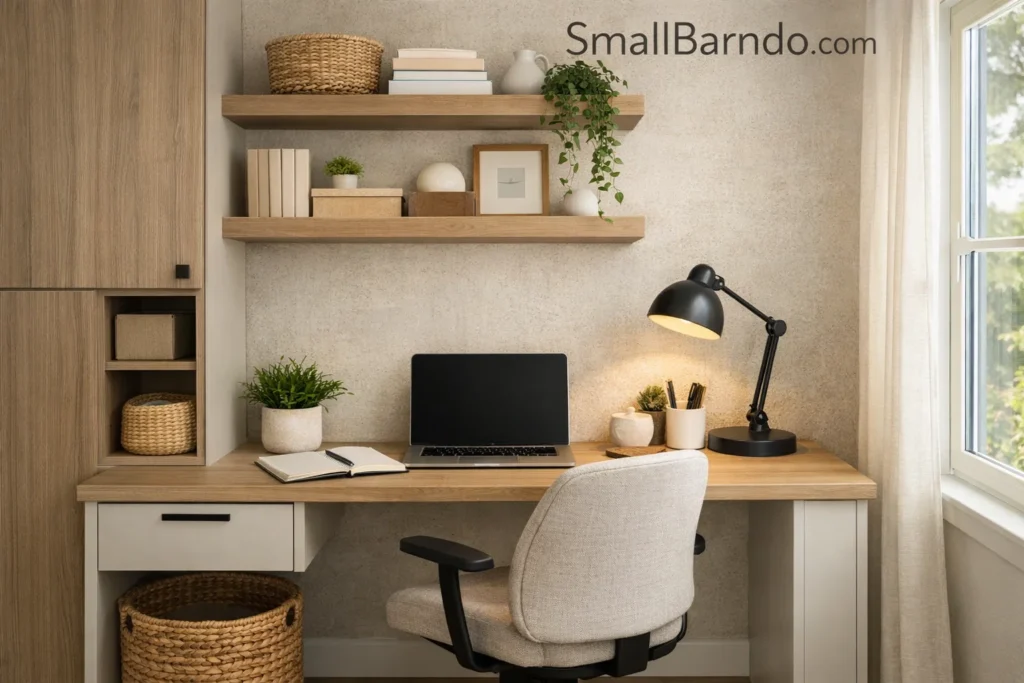
Corners are often the most underutilized areas in a room, frequently relegated to a dusty floor lamp or a neglected plant. However, a dedicated corner desk can provide you with a surprisingly large amount of legroom.
The Floating Corner Desk
Floating desks are a game-changer for small apartments. Because they lack legs, they maintain the “visual floor space” of the room, making your living area feel larger than it actually is.
- Visual Lightness: Choose a desk in a color that matches your walls to make it “disappear.”
- Cable Management: Since the desk is floating, wires can easily become an eyesore. Use “J-channels” or adhesive cable clips under the desk to keep your power bricks and USB cables out of sight.
Multi-Functional Corner Units
If you need more than just a place to put your laptop, look for units that incorporate a “hutch” or vertical shelving.
- Vertical Strategy: Use the wall space all the way to the ceiling. This keeps your physical footprint small while offering massive storage for books, printers, and files.
Comparison: Corner Desk vs. Straight Desk
To help you decide which is right for your layout, consider this comparison:
| Feature | Corner Desk | Straight Desk |
| Footprint | High (uses “dead” space) | Low (sits against flat wall) |
| Leg Room | Excellent (deep diagonal) | Standard |
| Flexibility | Limited to corners | Can be placed anywhere |
| Ergonomics | Great for dual monitors | Best for single laptop/monitor |
3. Nooks, Hallways, and Landing Zones
Sometimes, the best small home office ideas involve looking at the transition spaces in your home, the places you usually just walk through.
- Under the Stairs: Often called the “Harry Potter” approach, this is a brilliant use of sloped space. You will likely need custom shelving here because of the angled ceiling, but it provides a cozy, tucked-away feeling that aids concentration.
- The Wide Hallway: If your hallway is at least 5 feet wide, you can fit a shallow 15-inch “console” style desk against one wall. It’s enough for a laptop and a notepad without obstructing the flow of traffic.
- The Kitchen Command Center: Many modern homes are repurposing walk-in pantries or a section of a long kitchen island. If you’re someone who likes to work while the coffee brews or needs to keep an eye on dinner, this central “hub” can be your most productive zone.
4. 45 Design Elements for Your Small Office
To truly master your space, you need a toolkit of specific tactics. Here are 45 ideas categorized by how they solve your space problems.
Furniture & Hardware (Ideas 1-12)
- Fold-down “Murphy” Desks: These mount to the wall and fold up to look like a cabinet when you’re done.
- Ladder Desks: They use the wall for support and offer tiered shelving above the desk surface.
- Acrylic “Ghost” Chairs: Their transparency makes them invisible to the eye, preventing your room from looking “crowded.”
- Rolling Carts: Use a three-tier cart for your printer and files so you can wheel them into a closet at night.
- Standing Desk Converters: Compact versions let you switch to standing mode even on a tiny desk.
- Secretary Desks: These classic pieces have a “flip-down” front that hides your mess instantly.
- Floating Shelves as Desks: A sturdy, deep shelf mounted at 30 inches high is the ultimate minimalist desk.
- Nesting Tables: Use the smaller table as a pull-out keyboard tray or extra surface area.
- Monitor Arms: Clamping your screen to the back of the desk frees up roughly 20% of your surface area.
- Storage Ottomans: Replace a bulky office chair with an ottoman that holds your files inside.
- Wall-Mounted CPU Holders: If you use a desktop PC, mount the tower to the wall to keep your floor clear.
- Corner “L” Shelves: Place these above your desk to wrap your storage around you.
Storage & Organization (Ideas 13-25)
- Pegboards: Use these to hang everything from scissors to headphones. They are infinitely customizable.
- Magnetic Strips: Perfect for holding metal office supplies or even a series of small magnetic tins.
- Under-Shelf Baskets: Slide these onto your floating shelves to use the “dead air” underneath.
- Tension Rods: Place one at the back of a closet to hang lightweight organizers or “S” hooks.
- Desktop Risers: They create a second level on your desk for your monitor while providing a “garage” for your keyboard underneath.
- Magazine Files: Turn them sideways on a shelf to hide messy stacks of paper.
- Command Hooks: Use them on the side of your desk for your backpack or heavy-duty headphones.
- Drawer Dividers: Crucial for small desks, where you only have one drawer, make every inch count.
- Charging Stations: A multi-device dock prevents a “nest” of wires from taking over your workspace.
- Clipboard Walls: Hang clipboards to display your current “to-do” lists or project notes vertically.
- Rolling File Cabinets: These can double as an extra side table for your coffee or printer.
- Clear Bin Organization: Visibility is key in small spaces; if you can’t see it, you’ll forget you have it.
- Ceiling-High Bookcases: If the room is small, go up. The top shelves can hold “long-term” storage.
Lighting & Tech (Ideas 26-35)
- LED Strip Lighting: Run these behind your desk or under shelves for “bias lighting” that reduces eye strain.
- Monitor Light Bars: These sit on top of your screen and light only your desk, saving you the space of a lamp base.
- Wireless Everything: Minimize “visual noise” by switching to a wireless mouse, keyboard, and printer.
- Smart Bulbs: Use bulbs that shift from “cool white” for focus to “warm amber” for evening relaxation.
- Cable Sleeves: Bundle all your cords into one neat “snake” to hide the mess.
- Battery-Powered Puck Lights: If you can’t wire your closet, these adhesive lights are a lifesaver.
- Acoustic Foam Panels: In small nooks, sound can bounce. These panels stop echoes during your Zoom calls.
- Webcam Privacy Covers: A must-have for offices located in bedrooms or shared spaces.
- USB Hubs: Mount a hub to the side of your desk so you aren’t reaching behind your computer constantly.
- Noise-Canceling Headphones: In a small home, these are effectively your “office door.”
Decor & Well-Being (Ideas 36-45)
- Mirrors: Place a mirror opposite your desk to “double” the light and the perceived space.
- Small Snake Plants: They thrive in low light and improve the air quality in enclosed closets.
- Rug Zoning: Use a small area rug to physically define where the “office” ends and the “home” begins.
- Removable Wallpaper: Use a pattern with depth (like a forest or cityscape) to create a “view” where there isn’t one.
- Scented Diffusers: Use peppermint or rosemary scents to trigger your brain into “work mode.”
- Personal Gallery Wall: Surround yourself with 3-4 small pieces of art that inspire you.
- Desk Mats: A leather or felt mat protects your desk and adds a touch of luxury.
- Small Footrests: In a small space, you might not have the “perfect” chair; a footrest helps maintain ergonomics.
- Color Coding: Use one specific color for all your office supplies to make the nook look intentional and styled.
- The “End-of-Day” Box: A small box where you put your mouse and pens at 5 PM to “close” the office.
5. Overcoming the Limitations of Small Spaces
While small offices are cozy, they come with specific challenges that require strategic thinking. You cannot simply shrink a traditional office and expect it to work.
Ergonomics is Non-Negotiable
In a small nook, it’s tempting to use a dining chair or sit on a stool to save space. However, your back will pay the price. If you are working more than four hours a day, you must invest in a chair with lumbar support. The Herman Miller Sayl or the Branch Daily Chair are excellent examples of chairs with a smaller footprint that still offer professional-grade support.
Air Quality and Heat
Small spaces, especially closets, trap CO2 and heat. You should aim to leave your closet “door” (or curtain) open for at least 15 minutes every two hours to refresh the air. If the space feels “stuffy,” your cognitive performance can drop by up to 15%, according to air quality studies.
6. The Psychology of the Small Workspace
Your brain responds to environmental cues. In a tiny office, every detail matters.
- Color Analysis: Using “cool” colors like sage green or pale blue can actually make walls feel like they are receding, giving you more “mental” space.
- Biophilic Design: We are biologically wired to feel calmer around nature. Even if you don’t have a window, adding a small piece of preserved moss or a high-quality artificial plant can lower your cortisol levels.
Conclusion
Building a workspace in a limited area isn’t about how many square feet you have; it’s about how creatively you use the inches available to you. From the “closet” to the hallway nook, these small home office ideas prove that productivity doesn’t require a massive floor plan. By focusing on vertical storage, smart lighting, and ergonomic furniture, you can build a workspace that inspires you every single morning.
Take a look around your home right now. That “dead” corner or cluttered closet isn’t just wasted space, it’s your next corner office waiting to happen.
FAQ: Maximizing Your Small Office
What is the minimum size for a small home office?
While there is no legal minimum, for a functional experience, your desk should be at least 30 inches wide. Most people find that a depth of 20 to 24 inches is the “sweet spot” for balancing equipment needs with room flow.
How do I make a small home office look professional on video calls?
You should focus on what’s directly behind you, known as “The Frame.” Use a clean bookshelf, a piece of art, or even a stylish folding screen to hide your bed or kitchen. Good front-facing lighting is also key a small ring light can make a windowless closet look like a high-end studio.
Is a standing desk worth it for a small space?
Absolutely, but you should look for “compact” or “mobile” standing desks. Many modern models are only 36 inches wide, which fits perfectly into most corners. The ability to change positions is even more important in small spaces where you might feel more “stuck” than in a large room.
Can I put a small home office in my bedroom?
Yes, but you must create a “visual break.” Use a room divider or ensure your desk faces away from your bed. This helps your brain distinguish between the “productivity zone” and the “relaxation zone.”