Clever Barndominium Loft Ideas: Railing Designs, Stair Integration, and Safety Solutions
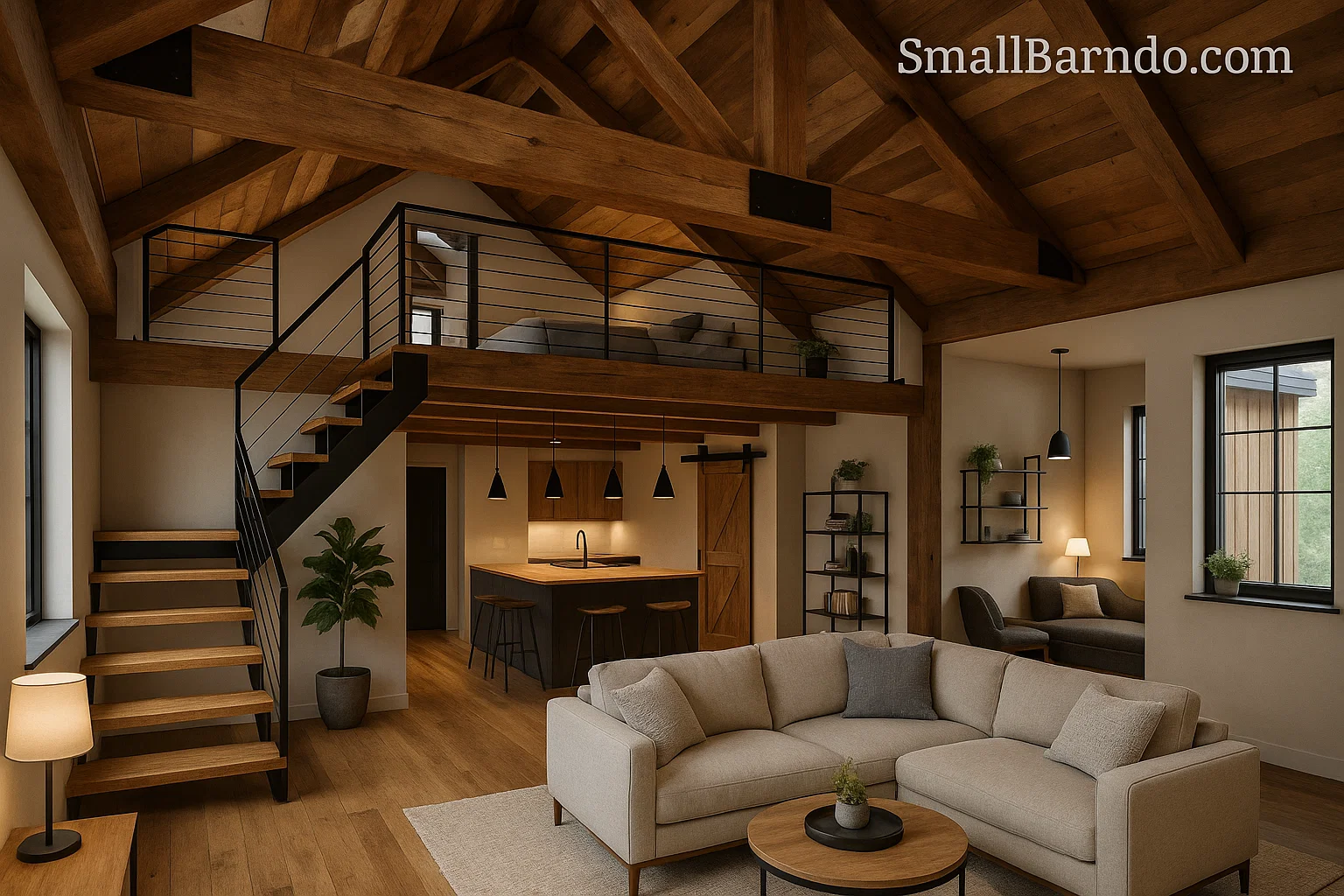
Have you ever stood on the floor of your new barndominium shell, looked up at that soaring ceiling, and just imagined? That open space isn’t just air; it’s potential. It’s the future reading nook, the guest suite, the home office, the perfect extra living area. The possibilities for creative barndominium loft ideas are limited only by the structural frame you’ve built.
But turning that vision into a safe, functional, and stunning reality requires careful planning, especially when it comes to the edge: the railing, and the path to get there: the stairs. I remember staring at the raw beams of my own barn-style home, overwhelmed by the options. Metal, wood, cable? Open tread or traditional? Safety is paramount, but style cannot be sacrificed. This guide is built from the detailed experiences of barndo owners and construction experts, providing you with the comprehensive, detail-oriented ideas you need to design a loft that’s not just an afterthought, but a showpiece of your barndominium. We’ll ensure your design is both breathtaking and compliant with essential building codes.
Table of Contents
Clever Barndominium Loft Ideas
Essential Railing Designs: Blending Safety with Barndominium Style
The railing is arguably the most critical design element of your barndominium loft Ideas. It defines the space, controls the view, and, most importantly, provides the necessary safety barrier. Your chosen design will significantly influence whether your space feels rustic, industrial, or minimalist.
Before any design choice, you must address code requirements. According to the International Residential Code (IRC), any elevated surface more than 30 inches above the adjacent ground level requires a guardrail or railing system.
- Minimum Height: The railing system should be a minimum of 36 inches measured vertically from the floor surface.
- Sphere Test (Opening Limitations): To protect children, the IRC mandates that the space between any two components of the railing system must be small enough to prevent the passage of a 4-inch diameter sphere. This is a non-negotiable safety element.
Modern Industrial & Minimalist Railing Solutions
For those who want to maximize the sense of openness and light, industrial or minimalist designs are your best option. They emphasize transparency, allowing the light from the main living area to stream into the loft, and vice-versa.
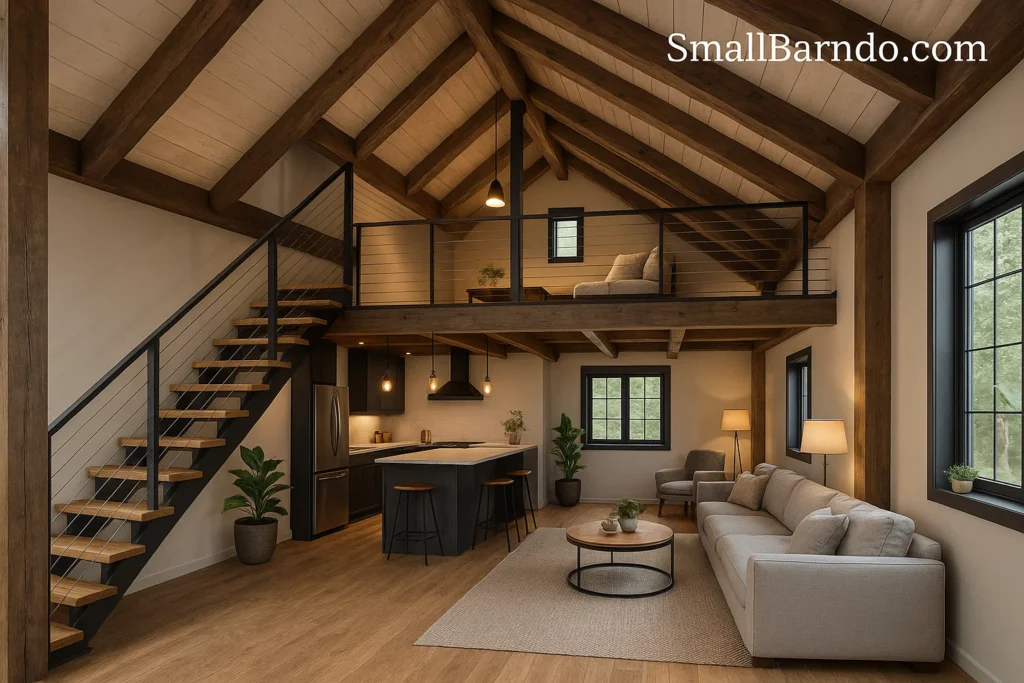
- Stainless Steel Cable Railing
- Aesthetic: This is the go-to choice for a sleek, modern, yet subtly industrial look, pairing perfectly with the steel structure of a barndominium.
- Pros: Minimal visual obstruction, allowing views from the loft to the floor below and vice-versa. It is extremely low maintenance and durable.
- Cons/Limitations: The material and installation can be pricey. More importantly, cable tensioning must be precise to maintain the necessary cable spacing to pass the 4-inch sphere test.
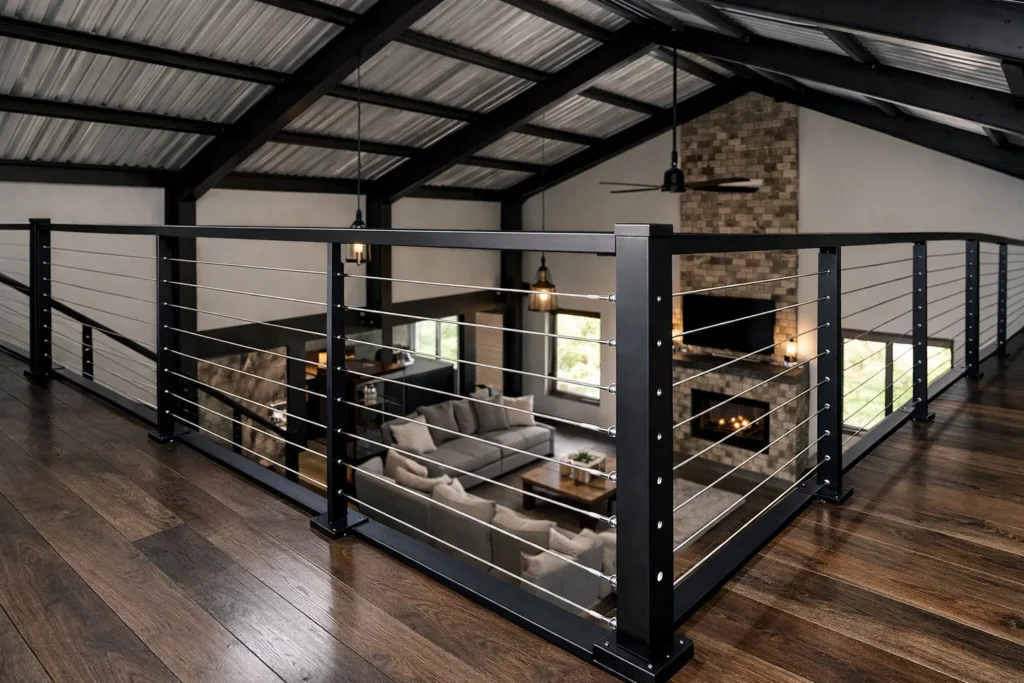
- Comparison: Compare cable railing to glass paneling: cable offers similar sight lines at a lower cost and easier maintenance, though it requires regular tension checks, whereas glass is virtually maintenance-free but significantly heavier and more expensive. Exception/Condition: While technically code-compliant, cables can create a perceived ladder effect if installed horizontally. Vertical cable systems are available, offering superior safety by eliminating climbing footholds.
- Horizontal/Vertical Metal Bar Railing (Picket)
- Design: These railings use clean, straight metal bars, typically black powder-coated steel or wrought iron.
- Safety Solution: If you opt for metal bars, a vertical orientation is the safest choice, as it completely eliminates any horizontal ledges that a child could use to climb. Horizontal bar railings, while visually striking and trendy, inherently risk creating that “ladder effect” and may face closer scrutiny from local building inspectors.
Rustic & Traditional Railing Designs
To lean into the “barn” aesthetic, incorporating wood and wire elements creates a sense of rustic luxury that anchors the loft to the rest of the structure.
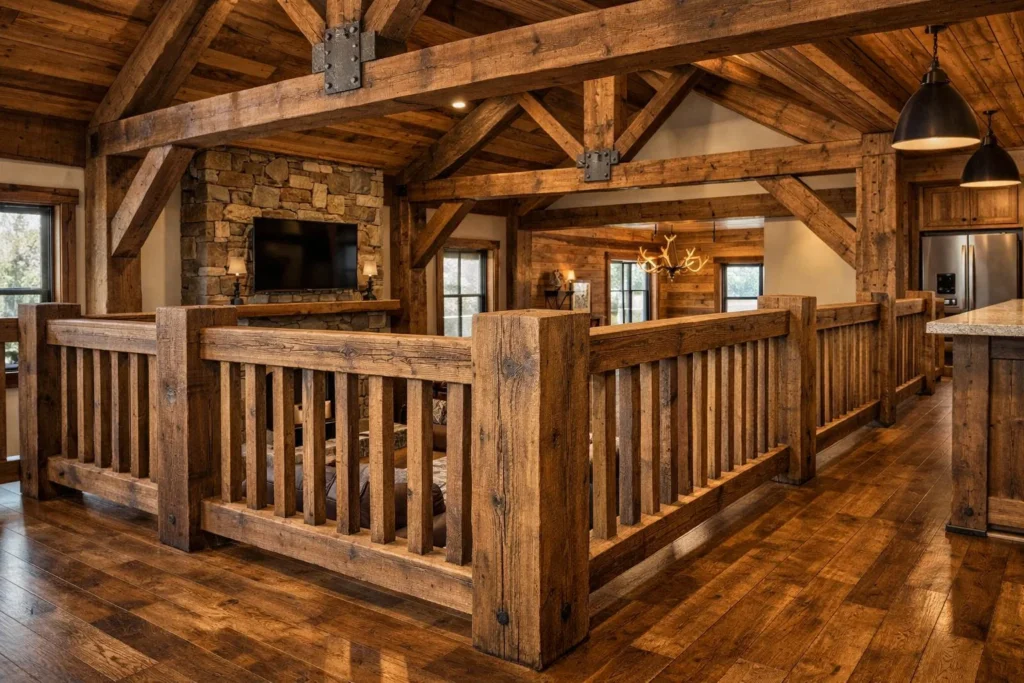
- Timber Post and Baluster Railings
- Aesthetic Integration: Use the same heavy timber material (e.g., reclaimed barn wood, rough-sawn cedar, or pine) as your barndominium’s truss or structural beams for an unmatched cohesive look.
- Style Note: Chunky 4×4 or 6×6 posts emphasize the rustic, robust feel of the building. Wood offers the easiest platform for DIY installation, though you must be meticulous in checking your baluster (vertical picket) spacing to ensure the 4-inch rule is met.
- Farmhouse X-Brace or Hog Wire Infill
- Description: This design often uses a wooden top and bottom rail with a unique infill.
- Hog Wire: Metal mesh (or hog wire) provides a semi-transparent, industrial-farmhouse aesthetic. It’s affordable and installation is straightforward. Limitation: The wire mesh gauge must be small enough to prevent the 4-inch sphere from passing through. You must specifically purchase fine-gauge mesh infill panels designed for this purpose.
- X-Bracing: Adding X-braces between the main vertical posts gives the railing a structural, barn-door aesthetic, reinforcing the authentic barndominium loft ideas theme.
Seamless Stair Integration: Accessing Your Barndominium Loft Ideas
The staircase is not just a utility; it is a piece of furniture, a major architectural feature of your open-concept barndominium. Your design choice will be a permanent statement, impacting flow, sightlines, and square footage.
- Data/Sources: When designing, you must adhere to the IRC’s fundamental rules for comfort and safety:
- Maximum Riser Height: The vertical rise of each step (riser) should be no more than $7 \frac{3}{4}$ inches.
- Minimum Tread Depth: The horizontal depth of the step (tread) should be a minimum of 10 inches.
- Dimensional Uniformity: The height and depth of all steps within a flight must not vary by more than $3/8$ of an inch.
Space-Maximizing Stair Designs
In a barndominium, where the floor plan is already expansive, maximizing usable space is key. These designs reclaim square footage without sacrificing safety.
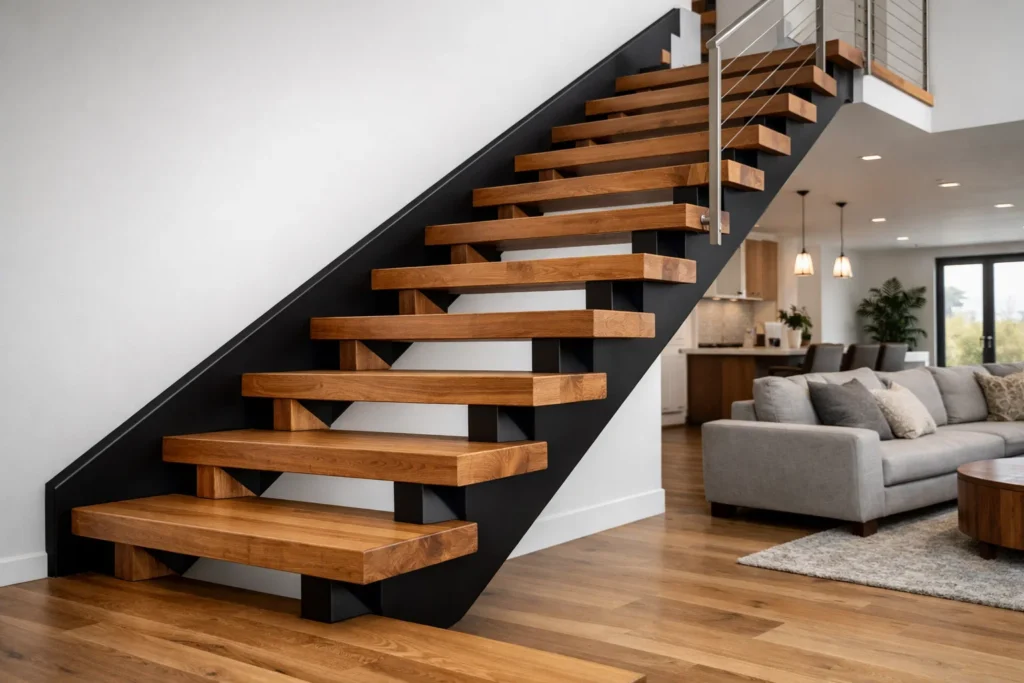
- Open Riser (Floating) Stairs
- Aesthetic/Advantage: Open-riser stairs, often constructed with thick timber treads bolted directly to a steel stringer or the wall, maximize light flow and maintain the spacious, voluminous feel of the main living space. They make the staircase feel less like a block and more like a sculpture.
- Condition/Exception: Because there is no riser (the vertical piece), building code often requires a mechanism to prevent a 4-inch sphere from passing through the risers if the tread is less than 11 inches deep. This usually means the gap must be closed. A common solution is to attach a triangular block or small vertical bar to the back of the tread.
- Spiral Staircases
- Advantage: The undisputed champion of space-saving solutions. Spiral stairs require the smallest footprint, making them ideal for small lofts or those placed in an awkward corner.
- Limitation: They are not ideal for high-traffic areas, moving large furniture, or use by individuals with mobility issues or pets. Comprehensive Answer: If you choose a spiral stair, recognize that you may need to plan for a secondary means of moving items (e.g., a simple, small lift or hoist system from the loft’s edge).
Traditional and Storage-Focused Stairs
If you have the floor space to spare, a traditional stair format offers unparalleled comfort, safety, and a hidden opportunity for storage.
- Straight-Run or L-Shaped Stairs with Landing
- Advantage: These formats are the most comfortable and safest, providing the most gradual slope and the largest treads.
- Clever Idea: The most innovative barndominium loft ideas incorporate storage into this design. Utilize the large, usually dead space underneath the stairs for:
- Built-in Drawers: Deep pull-out drawers for seasonal clothing, linens, or tools.
- A Hidden Pantry or Wine Storage: Perfect for non-perishable goods.
- Integrated Pet Nook: A cozy, custom dog kennel or feeding station, keeping pet supplies off the main floor.
Essential Safety Solutions and Loft Functionality
Safety in your loft extends beyond the railing. Functionality means ensuring the space is habitable, well-lit, and provides a clear exit plan. Don’t overlook these critical, practical design considerations.
Lighting and Electrical Considerations
Lighting should prioritize safety on the route, followed by ambiance in the space itself.
- Task Lighting: Install recessed lights on motion sensors on the lower portion of the stairwell, and ensure adequate overhead lighting at the top and bottom of the stairs. Always use three-way switches so you can turn the stair light on from both the ground floor and the loft.
- Ambient Lighting: Recessed can lights are perfect for maintaining maximum headroom in the loft itself. However, consider a statement piece, such as an oversized chandelier or fan, hanging in the double-height space. This feature can be viewed and enjoyed from the loft, turning the ceiling fixture into a design element for both floors.
- Outlets: This is a crucial, often forgotten, element of loft functionality. Plan for multiple wall outlets, and crucially, install floor outlets in the loft’s main living area. This eliminates the need for running potentially hazardous extension cords across the floor, a major tripping hazard.
Fire Egress and Emergency Planning
If your loft is intended to be used as a sleeping space (i.e., a guest room or master suite), it must meet fire egress requirements. This is a non-negotiable legal and safety component.
- Condition: If the loft is used as a bedroom, it requires a secondary means of escape (egress).
- Egress Window Requirements (IRC R310): The secondary means of egress is usually an approved window that meets these strict criteria:
- Minimum Opening Area (Net Clear): Not less than 5.7 square feet (for upper levels).
- Minimum Opening Height (Net Clear): Not less than 24 inches.
- Minimum Opening Width (Net Clear): Not less than 20 inches.
- Maximum Sill Height: The bottom of the opening cannot be more than 44 inches above the finished floor.
- Comprehensive Answers: You must measure the net clear opening, the actual space available when the window is fully open, not the glass area. A casement window is often the best choice for meeting these requirements with minimal frame obstruction, compared to a double-hung window.
Top 3 Clever Barndominium Loft Ideas for Functionality
Your loft space is valuable, and maximizing its utility requires creative foresight. Here are three ideas that move beyond the basic guest room concept.
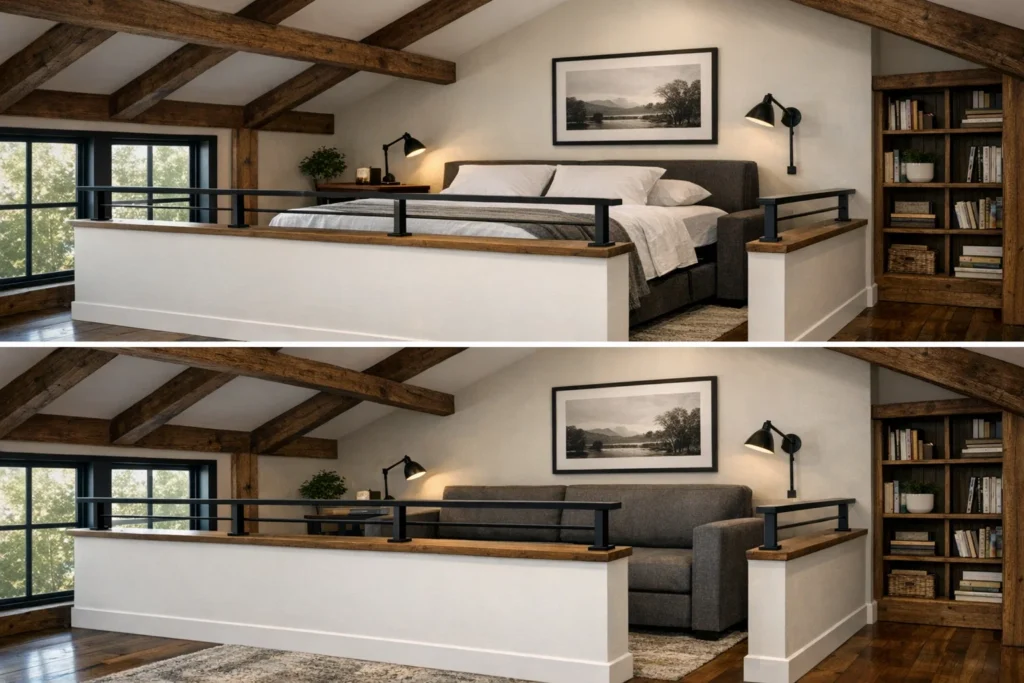
- Idea 1: The ‘Hidden’ Guest Suite
- Design Execution: Design the loft with a half-wall (often called a knee wall) that comes up just below the required railing height (e.g., 34 inches). The remaining 2-4 inches can be finished with your code-compliant railing.
- Functionality: The knee wall provides the perfect architectural structure to conceal furniture. When not in use, a pull-out sofa or a horizontal Murphy bed is invisible, maximizing the open feel of the loft. When guests arrive, the space instantly transforms into a private suite.
- Idea 2: The Catwalk Library/Reading Nook
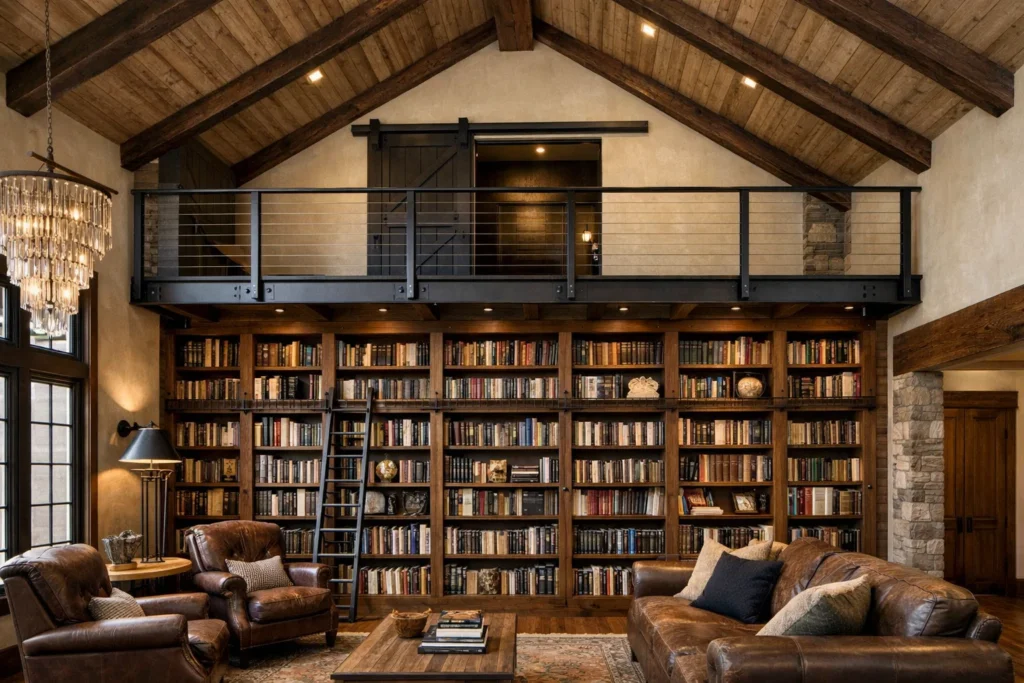
- Design Execution: For those who want the aesthetics of a loft without consuming the entire ceiling height of the great room, design the loft access as a narrow catwalk instead of a full floor. The catwalk only extends a few feet into the main space, connecting to a fully enclosed room on the back wall.
- Depth of Analysis: The open area below the catwalk is perfect for a gallery, a display wall, or, most popularly, a two-story library. Line the wall below the catwalk with floor-to-ceiling bookshelves, turning a utility space into a sophisticated, visual centerpiece of your home.
- Idea 3: Dedicated Home Gym Zone
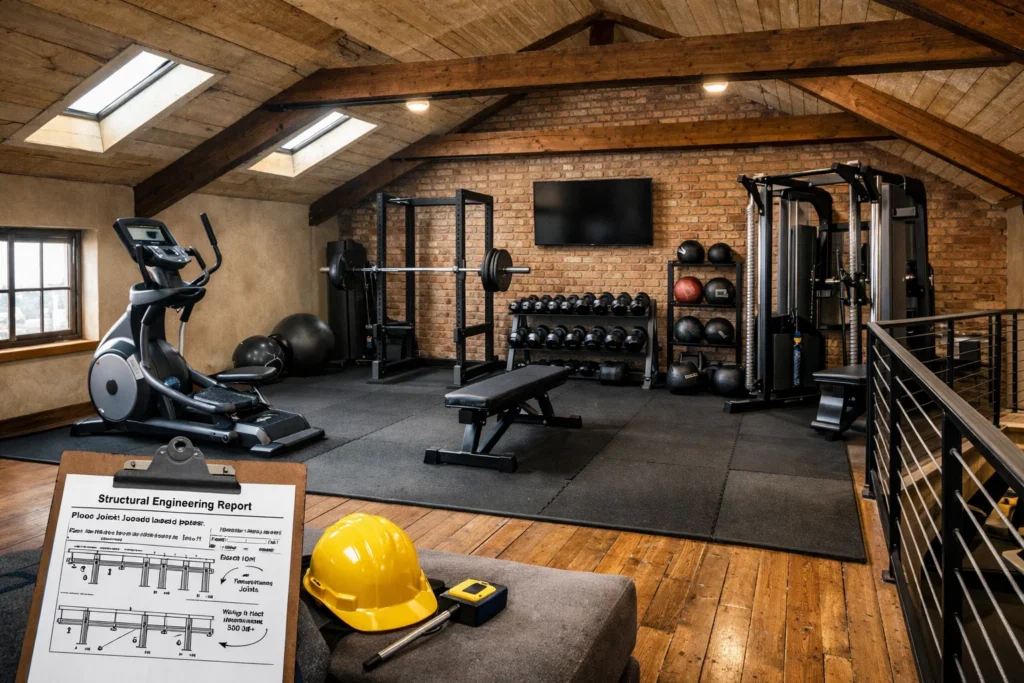
- Functionality: A loft is an excellent place for a home gym as it keeps equipment out of the main living space and away from ground-level clutter.
- Condition: This choice requires planning with your structural engineer. Ensure the floor joists and subfloor in the loft area are specifically engineered for the heavier static and dynamic load (weight and impact) of gym equipment. An elliptical machine or free-weight rack exerts far more concentrated stress than standard furniture. Failing to plan for this can result in bouncing or, worse, structural damage.
Conclusion: Your Barndominium’s Defining Feature
Your loft is more than just a bonus room; it’s the signature feature of your barndominium, elevating both your home’s value and your daily living experience. By making informed decisions from carefully choosing a barndominium railing design that complements your aesthetic to integrating code-compliant stairs that balance accessibility with space-saving, you ensure the view from the top is as safe and inspiring as you always imagined.
Now that you have the knowledge of design trends and the necessary safety parameters, it is time to take the next step.
FAQ Section: Your Barndominium Loft Ideas Questions Answered
- Q1: What is the ideal height for a Barndominium loft ceiling?
- A: For occupant comfort and to ensure the most functional loft space, the standard recommendation is a minimum ceiling height of 7 feet. While local building codes typically require a minimum of $6 feet, 8 inches, aiming for $7 feet or higher will make the space feel less claustrophobic and more inviting. To achieve this, the main floor below should be at least $10 feet tall.
- Q2: Are horizontal Barndominium Loft Ideas railings a safety risk?
- A: Yes, horizontal railings are generally considered a greater safety risk than vertical ones. While they are visually modern, the horizontal members create a “ladder effect” that can be used by small children to climb, potentially leading to a fall. This is why vertical pickets or tightly spaced cable railings are a safer, more recommended alternative for barndominium loft ideas, as they inherently eliminate climbing footholds while still meeting the IRC’s 4-inch sphere test rule.
- Q3: How much does it cost to add a loft and stairs to a barndominium?
- A: The total cost can vary widely based on material choice and complexity. A simple utility loft (no plumbing/electrical) with basic wooden stairs can start around $5,000–$8,000. A large, fully finished loft with custom cable railings, floating stairs, electrical, and HVAC integration could easily exceed $20,000–$30,000. The final price hinges on the level of finish you select.
- Q4: Do all lofts require a separate fire exit?
- A: No, only if the loft is considered a sleeping space (e.g., a bedroom, guest room) by the International Residential Code. If your loft is strictly used as non-habitable storage, a library, or a home office that is not used for sleeping, a single stair access is usually sufficient. Always check with your local building code official before finalizing your barndominium loft ideas design.