
The Complete Cost to Build a Small Home: Per Square Foot Breakdown (2026)
Have you ever scrolled through social media, captivated by images of minimalist, perfectly designed small homes? Perhaps you envision the financial freedom, the dramatically reduced carbon footprint, and the sheer simplicity of living with only what you truly need. It is an incredibly appealing vision, one that promises an escape from the “bigger is better” treadmill.
However, the reality of construction often hits hard: the actual cost to build a small home can sometimes feel disproportionately high, challenging the very notion of ‘budget living.’ You may have heard whispers of “$150 per square foot,” only to realize those numbers are often incomplete, outdated, or apply only to the cheapest possible shell.
In the dynamic construction market of 2026, building a compact, high-quality home requires realistic, up-to-date figures and a detailed understanding of where every dollar goes. High labor costs and ongoing material volatility (with projected aggregate increases around $8\%$ for certain materials) mean you must approach your budget with precision. This comprehensive guide, based on 2026 projections and construction data, breaks down the true cost to build a small home from the foundational soil to the final doorknob ensuring your small home journey is one of certainty, not surprise. We will show you how to estimate your project accurately and where you can genuinely find savings.
Table of Contents
Understanding the 2026 Small Home Building Cost Per Square Foot: The Small Home Premium
To set a realistic budget, you must first acknowledge a critical paradox of construction: building a smaller home does not automatically mean a lower cost per square foot. In fact, for very small homes, this metric is typically inflated compared to a standard-sized house.
The Current National Average and Size Range (2026 Projections)
Based on projected industry trends for 2026, the national average for new residential construction (excluding land and soft costs) is expected to remain between $160 and $350+ per square foot.
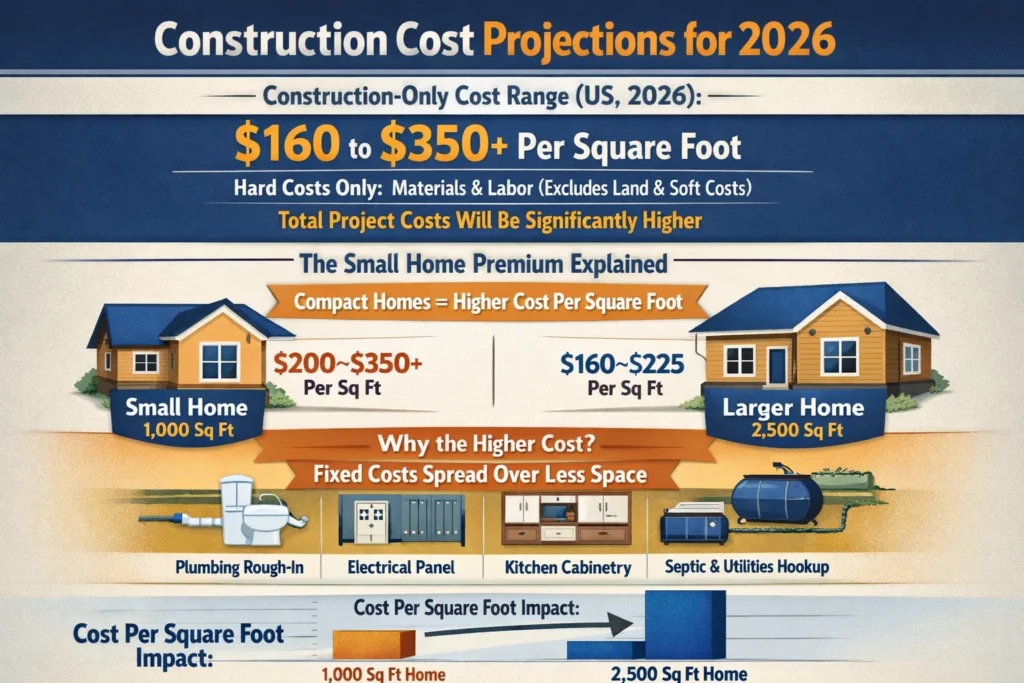
- Construction-Only Cost Range (US, 2026):$160 to $350+ per square foot.
- Important Limitation: This figure represents the “hard costs” only (materials and labor) and does not cover land, soft costs (design, permits), or site preparation. Your total project cost will be significantly higher.
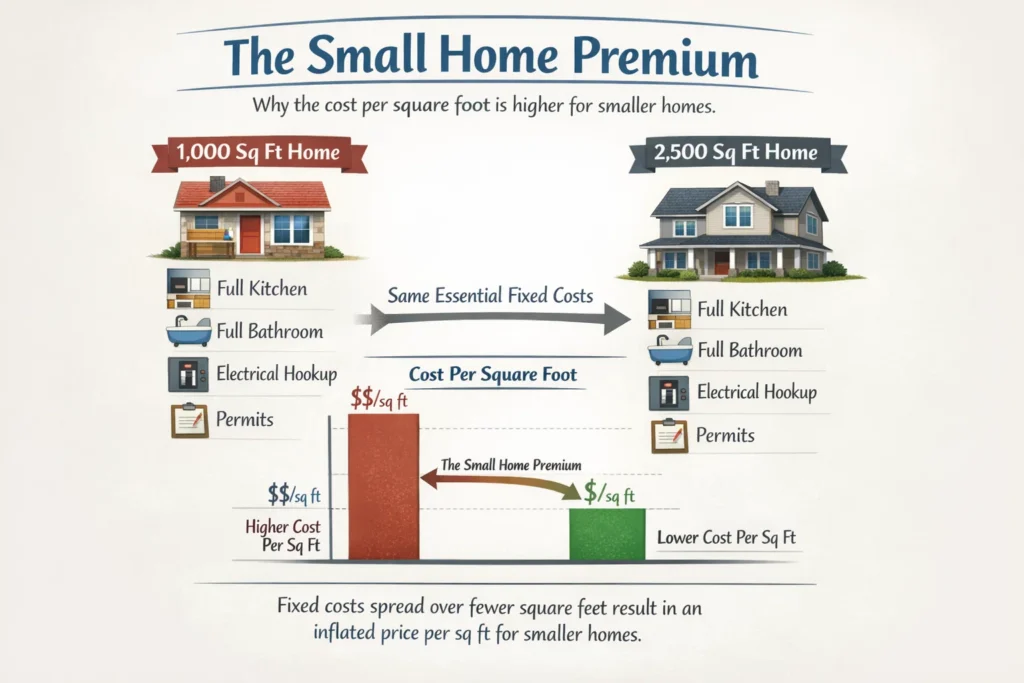
- The Small Home Premium Explained: If your vision is a truly compact home (e.g., 600–1,200 square feet), you will almost certainly face a highercost per square foot than someone building a 2,500 square foot home.
- The Reason: Fixed costs, like the plumbing rough-in for a single bathroom, the electrical panel, the kitchen cabinetry, and the septic hookup, must be distributed over fewer square feet. A 1,000 sq ft home needs the same main utility connections as a 2,500 sq ft home, making the cost-per-foot appear much steeper.
Cost Comparison Table (2026 Estimated Construction-Only)
To illustrate the effect of the small home premium, consider these estimated ranges for construction costs only:
| Home Size (Sq. Ft.) | Estimated Cost/Sq. Ft. | Total Construction Cost Range |
| 600 (Mini-Home/ADU) | $250 – $400+ | $150,000 – $240,000+ |
| 1,000 (Small Starter Home) | $180 – $320 | $180,000 – $320,000 |
| 1,500 (Efficient Mid-Size Home) | $160 – $300 | $240,000 – $450,000 |
Limitations of Relying Solely on Per-Square-Foot Estimates
While useful for benchmarking, relying exclusively on a cost-per-square-foot figure can derail your budget. It completely fails to account for three major, high-cost variables:
- Site Complexity: Rocky soil, steep slopes, or remote locations can add tens of thousands of dollars to the foundation and access costs, regardless of the home’s size.
- Finish Quality: A basic, builder-grade 1,000 sq ft home at $180/sq ft ($180,000) is drastically different from a high-end, custom 1,000 sq ft home with imported tile and custom cabinetry, which could easily cost $350/sq ft ($350,000).
- Soft Costs: These vital pre-construction expenses are almost entirely ignored in the per-square-foot calculation.

Detailed Breakdown: The Three Pillars of Your Project Budget
A well-structured construction budget is divided into three distinct cost categories that logically flow from initial planning to final occupancy. For the average new build, hard costs now account for approximately 64.4% of the total project price, making the other two categories, Soft Costs and Site Work, more crucial than ever to control.
1. Soft Costs: The Upfront Essentials (20-30% of Total Project Budget)
These non-construction, professional, and regulatory fees are typically the first to hit your ledger and are largely fixed, irrespective of the home’s square footage. You must capture and budget for these costs early.
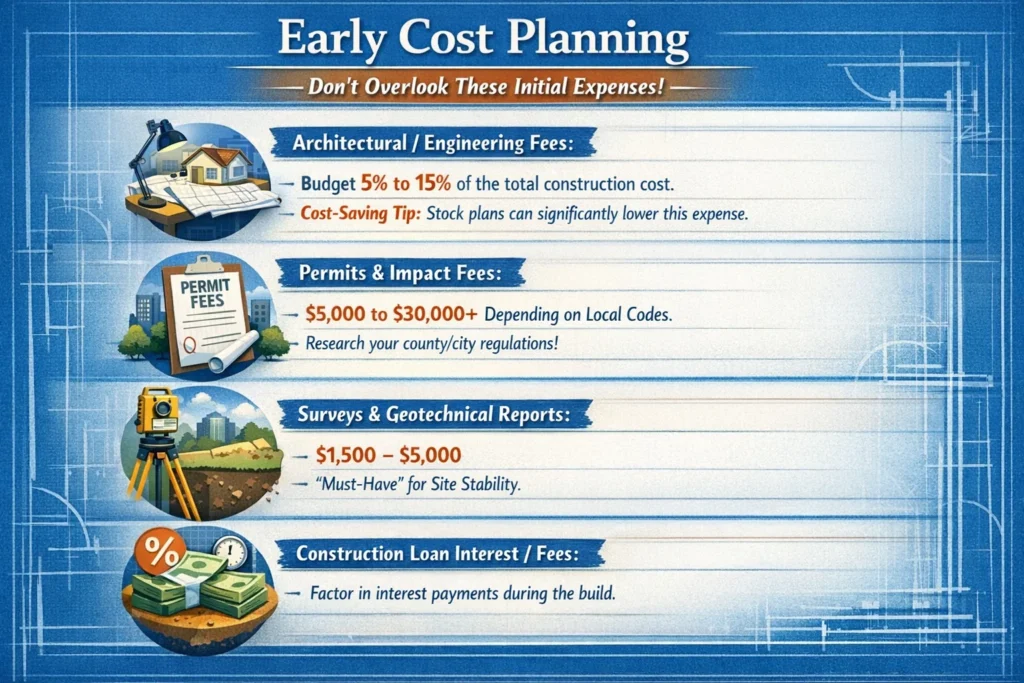
- Architectural/Engineering Fees:
- For a fully custom design, budget $5 to $15 of the total construction cost.
- Cost-Saving Tip: Utilizing pre-designed (stock) plans can dramatically reduce this cost while still allowing minor, cost-effective modifications.
- Permits & Impact Fees: This is arguably the most variable soft cost. It can range from $5,000 to over $30,000 depending on the municipality, especially in high-growth or environmentally sensitive areas. Research your specific county/city codes immediately.
- Surveys & Geotechnical Reports (Soil Testing): $1,500 – $5,000. This testing is non-negotiable; it determines the stability of the ground and the type of foundation you must build.
- Construction Loan Interest/Fees: If you are financing the build, factor in the interest payments accrued during the construction phase.
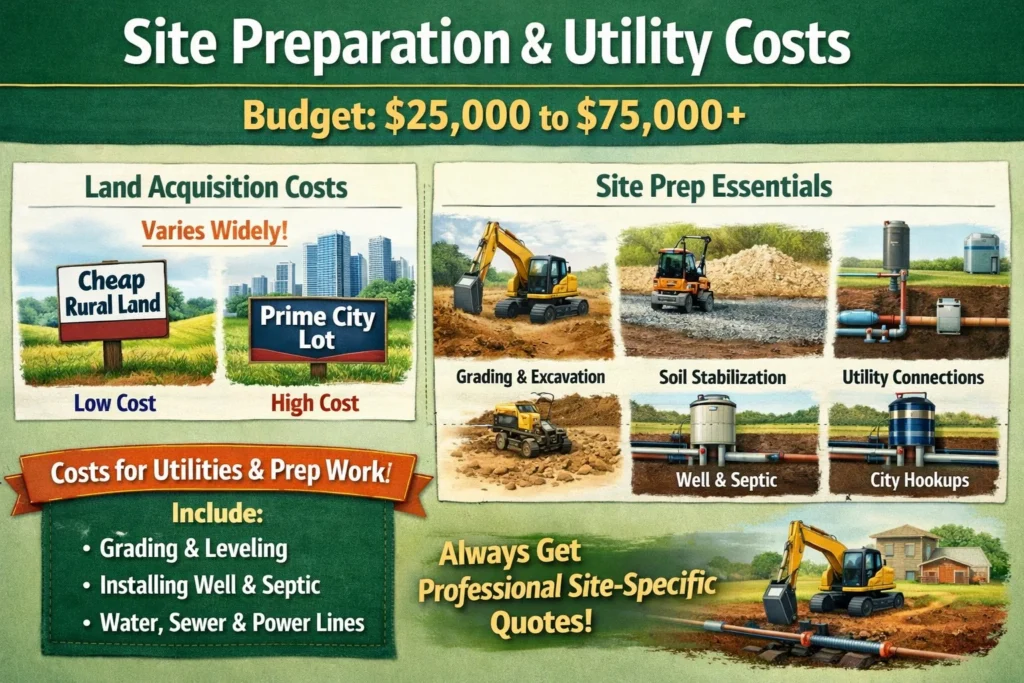
2. Site Work & Foundation: The Budget Risk Factors (10-25% of Total Cost)
Site conditions and utility access are the biggest variables that can sink a budget. You must obtain detailed quotes before breaking ground.
Foundation Type Comparison
The required depth of your frost line and your land’s topography will dictate your foundation choice, and the price difference is significant:
| Foundation Type | Typical Cost Range (Per Sq. Ft.) | Pros for Small Homes | Cons & Caveats |
| Slab-on-Grade | $8 – $18 | Most affordable, fastest to pour, more energy-efficient in warmer climates. | Difficult/expensive to repair plumbing lines embedded in the slab. |
| Crawlspace | $12 – $25 | Excellent for sloped lots, provides easy access to plumbing/HVAC/utilities for repairs. | Requires ventilation/encapsulation to control moisture; more expensive than a slab. |
| Full Basement | Adds $\ge 50\%$ to Construction Cost | Essentially doubles your usable square footage for less than the cost of a second story. | Highest upfront cost, requires the most excavation, only feasible on suitable land. |
The High Cost of Utility Hookups
If your plot is remote or rural, connecting utilities will be a significant, fixed expense.
- Urban/Suburban Hookup (Near Municipal Lines):
- City Water Connection: $1,000 – $6,000
- City Sewer Connection: $1,500 – $5,700
- Rural/Remote Hookup (Private Systems):
- Private Well Drilling: $5,000 – $15,000+ (depth dependent)
- Septic System Installation: $5,000 – $30,000+ (soil-dependent)
- Distance Factor: Electrical and gas line extensions charge by the linear foot, often costing $5–$25 per linear foot for electric/gas if the nearest pole is far away.
3. Hard Costs: Materials and Labor (60-80% of Total Cost)
This is the actual construction. Given rising construction wages (exceeding $4\%$ annually) and material volatility (driven by tariffs and supply chain), optimizing this area is key to managing the total cost to build a small home.
- Structural Shell (Framing, Roofing, Siding):
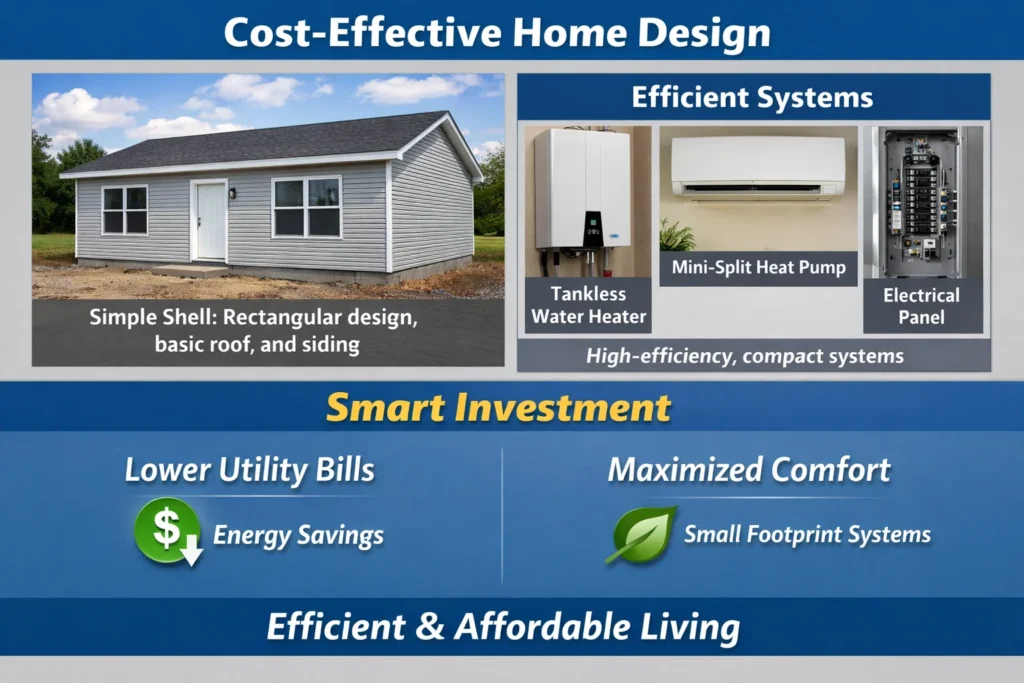
- The simplest design is the cheapest. A rectangular footprint with a basic roof structure minimizes labor and material waste. Complex rooflines (e.g., gambrel, multiple gables) drive up framing costs significantly.
- Systems (HVAC, Plumbing, Electrical):
- Paradox of Systems: A 1,000 sq ft home requires a full electrical panel, a water heater, a functional furnace/heat pump, and a full run of pipe to the sewer/septic. These are high-cost, high-labor items that are not dramatically scaled down with home size.
- Smart Solution: Invest in high-efficiency, small-footprint systems like a tankless water heater or a mini-split heat pump. While the initial investment might be higher, the long-term energy savings in a compact, efficient structure offer a fantastic return.
- Interior Finishes (The Major Variable): This is where you have the most control over the cost to build a small home.
| Finish Level | Key Characteristics | Cost Impact |
| Builder Grade | Laminate countertops, basic vinyl plank flooring, stock cabinets, entry-level fixtures. | Lowest per-square-foot cost. Focuses on function and durability. |
| Mid-Range | Solid surface or lower-end granite/quartz, engineered hardwood, semi-custom cabinetry. | Adds $\mathbf{\$20-\$40}$ per sq ft to overall construction cost. |
| Custom/Luxury | Imported marble, high-end appliance packages, custom millwork, designer lighting/tile. | Can add $\mathbf{\$50-\$100+}$ per sq ft, even on a small floor plan. |
Key Factors that Significantly Inflate the Cost to Build a Small Home
You cannot control the market, but you can control your design choices. Being aware of these cost drivers is critical.
Design Complexity vs. Simplicity
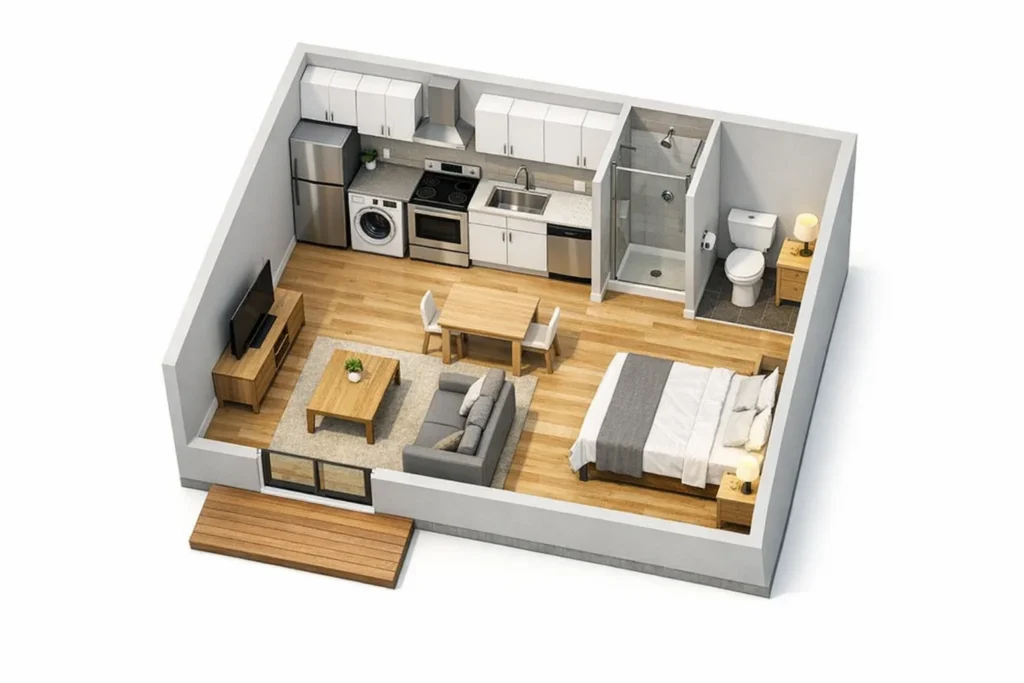
- Embrace Simple Geometry: A square or rectangular foundation minimizes concrete, lumber cuts, and wasted material. Every “corner” you add to the perimeter of the house adds complexity, labor, and framing cost.
- Minimize Wet Rooms and Interior Walls: Grouping all plumbing (kitchen, laundry, bathroom) onto one wall or stacking them vertically (for a two-story small home) drastically reduces the length of copper or PEX required, cutting both material and specialized labor costs. An open-concept floor plan requires fewer expensive interior doors and less drywall.
Geographic Location and Local Market Conditions
The same 1,000 sq ft plan built in Scranton, Pennsylvania, (forecasted for modest price growth) versus San Francisco, California (high labor and permitting costs), will yield vastly different totals.
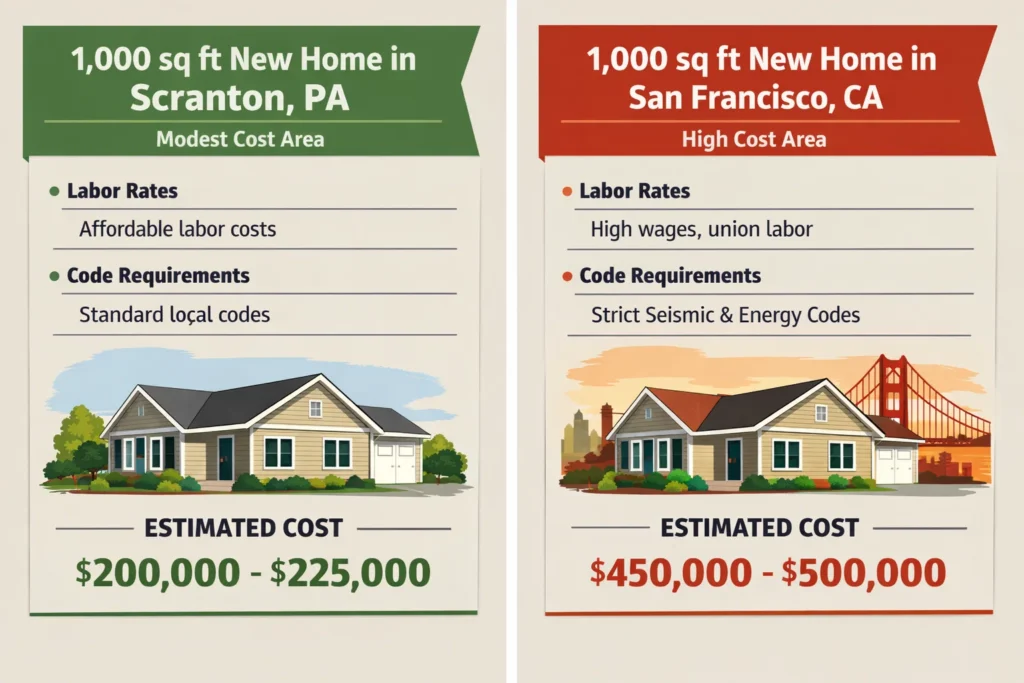
- Labor Rates: Construction wages are rising faster than inflation. Areas with high demand and strong union presence will have substantially higher hourly labor rates.
- Code Requirements: Areas with strict seismic, wind, or energy-efficiency codes (like California’s Title 24, which promotes energy-efficient residential construction) require more specialized materials and inspections, driving up costs.
Custom vs. Pre-Designed Plans: The Time-vs-Money Trade-off
- Custom Plans: While giving you the perfect home, they necessitate long, expensive periods of consultation with architects and engineers (the high end of the $5\%$-$15\%$ fee range).
- Pre-Designed (Stock) Plans: These are drawn to standard code, have proven efficiency in construction, and carry a fraction of the design cost, allowing you to move faster from concept to permitting. For those aiming to minimize the cost to build a small home, this is a powerful strategy.
Smart Budgeting and Cost-Saving Strategies for 2026
You can offset the ‘small home premium’ with intelligent planning and savvy execution.
Financial Planning and Contingency: Prepare for the Unknown
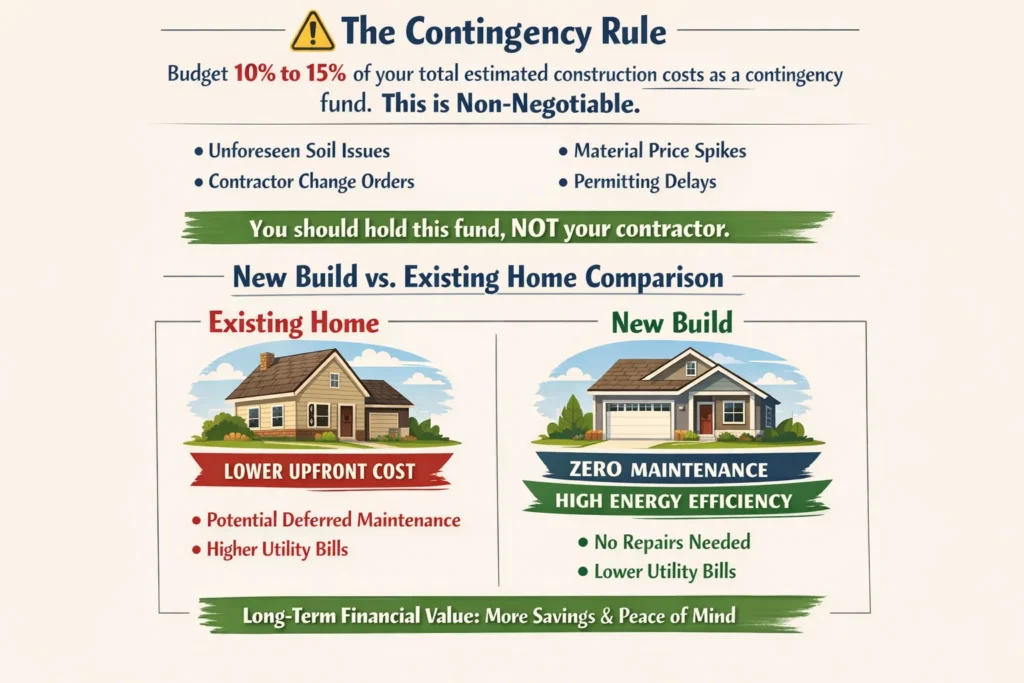
- The Contingency Rule: Industry experts unanimously recommend budgeting for a 10% to 15% contingency fund on top of your total estimated construction costs. This is non-negotiable. This fund covers the “unknowns” like unforeseen soil issues, contractor change orders, material price spikes, or permitting delays. You should hold this fund, not your contractor.
- New Build vs. Existing Home Comparison: You will likely find an existing small home is cheaper upfront. However, a new small home offers zero deferred maintenance (no need for a new roof or HVAC for decades) and superior energy efficiency (lower monthly utility bills), providing significant long-term financial value that an older home cannot match.
Tactical Cost Reductions to Implement Now
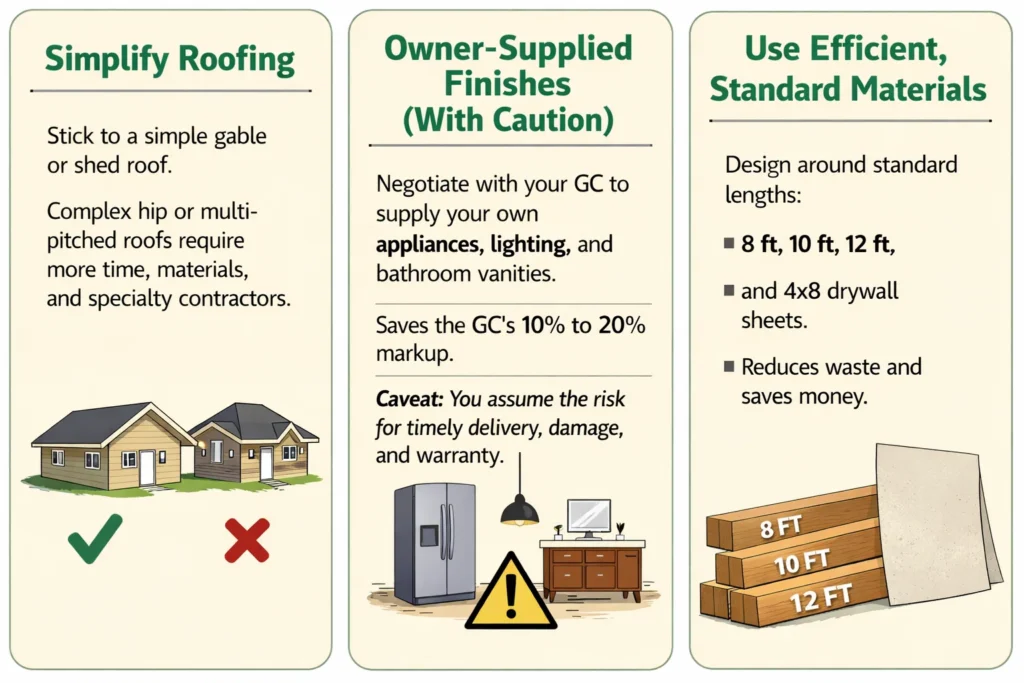
- Simplify Roofing: Stick to a simple gable or shed roof. Complex hip or multi-pitched roofs require more time, materials, and specialty contractors.
- Owner-Supplied Finishes (With Caution): Negotiate with your General Contractor (GC) to purchase and supply your own high-cost fixtures like appliances, lighting, and bathroom vanities. This saves you the GC’s $10 to $20 markup.
- Caveat: You assume the risk for timely delivery, damage, and warranty. If materials are late, the GC may charge you for downtime. Manage your logistics meticulously.
- Use Efficient, Standard Materials: Lumber is priced in specific lengths. Designing your home around standard lumber lengths (e.g., 8-foot, 10-foot, 12-foot) and standard drywall sheets (4×8) dramatically reduces material waste, which directly saves you money.
Realizing Your Right-Sized Dream
Building a small home in 2026 is a statement of commitment to intentional, sustainable, and financially sound living. It is not, however, a guaranteed path to a lower price tag on day one. It is the ultimate path to a smarter, more efficient, and more personalized home over the long term.
Successfully navigating the cost to build a small home requires a laser-like focus on controlling fixed expenses, mitigating risk through a robust contingency fund, and understanding the impact of design complexity. By using this detailed breakdown as your guide, you can move beyond simple per-square-foot myths and create a realistic, actionable budget that honors both your minimalist dream and your financial reality.
Are you ready to turn your detailed budget into a successful build?
FAQ: Your Quick Guide to the Cost to Build a Small Home
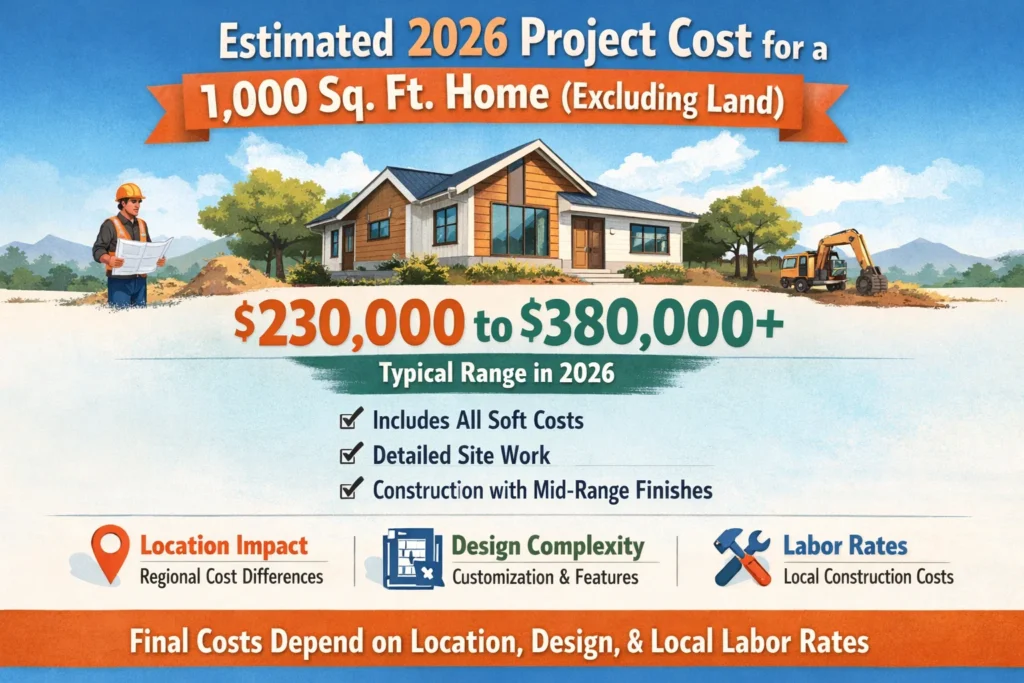
Q: What is the estimated total cost to build a small home (around 1,000 sq ft) in 2026?
A: Excluding the cost of land, the estimated total project cost for a 1,000 square foot home in 2026 typically ranges from $230,000 to $380,000+. This comprehensive range includes all soft costs, detailed site work, and construction with mid-range finishes. The final figure is highly sensitive to your chosen location, the complexity of the design, and local labor rates.
Q: Why is the cost per square foot to build a small home often higher than a larger one?
A: Small homes incur many of the same fixed costs as larger homes, but these costs are divided over fewer total square feet. For instance, a 1,000 sq ft home and a 2,500 sq ft home both require a full kitchen, at least one full bathroom, an electrical service hookup, and permits. The high cost of these essential, non-negotiable items (which do not scale down with the floor plan) results in an inflated cost per square foot for smaller structures, the phenomenon known as the Small Home Premium.
Q: How much should I budget for land and utility hookups in addition to the construction cost?
A: Land costs are entirely driven by the market and can range from almost nothing (rural, inherited land) to hundreds of thousands of dollars (prime urban lots). For site preparation and utility hookups, budget a substantial amount: anywhere from $25,000 to over $75,000. This budget must cover grading, soil stabilization, and especially utility connection fees, which are extremely high for private well and septic systems or for extending municipal lines over long distances. Always obtain professional, site-specific quotes for these services.