Small Barndominium: The Complete 2026 Guide to Costs, Sizes, and What Nobody Tells You
You’ve seen them on Instagram. Maybe you’ve scrolled through a few floor plans at midnight, already mentally placing your kitchen island. The dream is real: a small barndominium on your own land, built the way you want it, without the $400,000 price tag of a traditional custom home.
But here’s the thing: the internet is full of “build your barndo for $50K!” content that leaves out about $150,000 worth of reality. So let’s fix that. This guide answers every question real people are actually searching for, from how big you can build on a $100K budget to whether banks will even lend you the money, with straight, honest numbers.
Table of Contents
Key Takeaways
- A small barndominium (under 2,000 sq ft) realistically costs $112,800–$300,000+ fully finished, depending on size and finishes.
- Barndominium kits start at $20–$35/sq ft for the shell only; interior finishes, utilities, and site prep add a high cost on top.
- On a $100K budget, expect a modest finished structure of around 600–1,000 sq ft, or a shell/dry-in for up to 1,500 sq ft if you DIY the interior.
- Barndominiums are generally cheaper per square foot than traditional homes ($60–$160/sq ft vs. $150–$400/sq ft).
- Financing is the biggest hurdle banks treat barndos as non-standard, so you’ll likely need a construction loan or portfolio lender.
- The smallest practical barndominium for full-time living is around 400–600 sq ft, though most people find 800–1,200 sq ft to be the sweet spot.
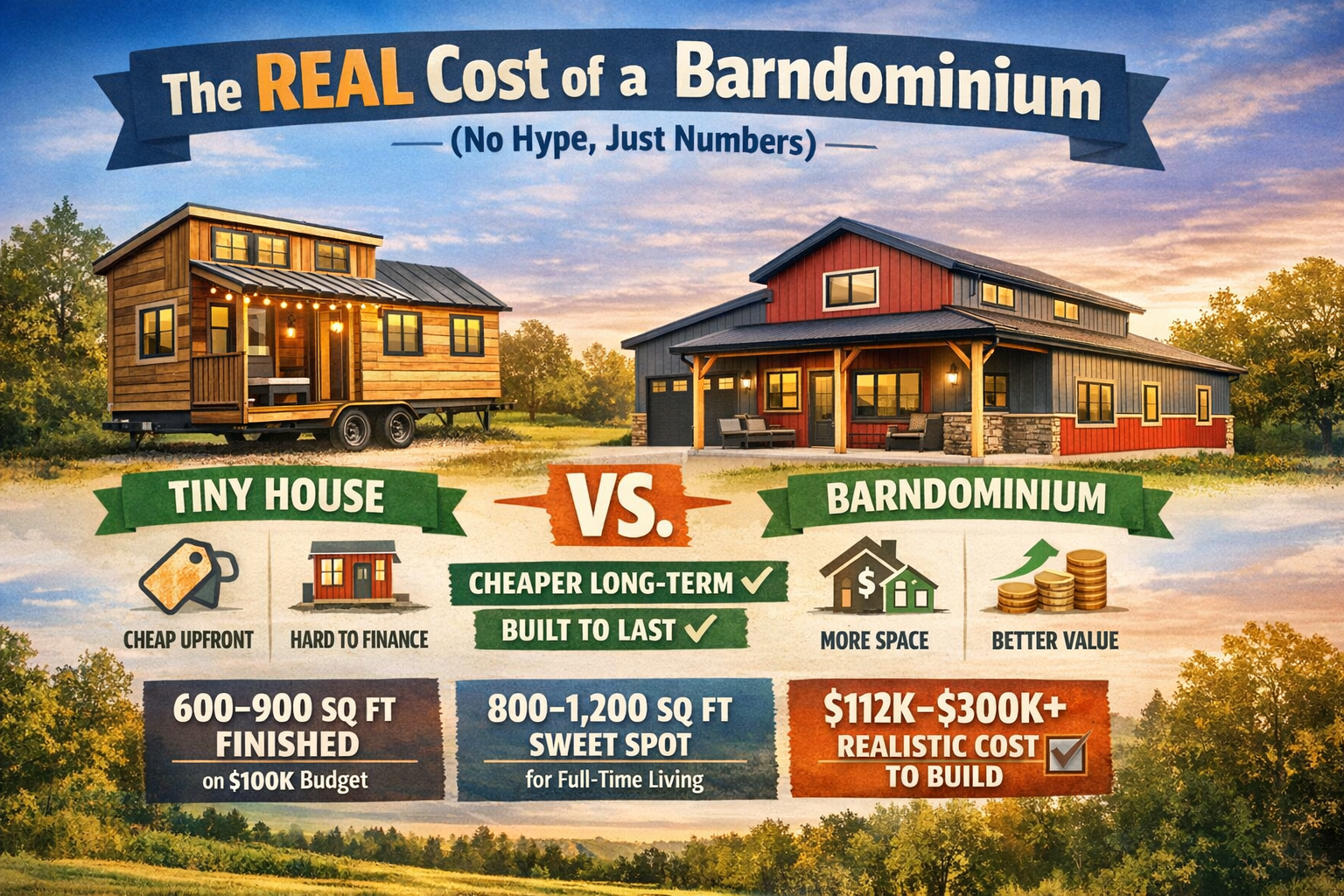
Are Barndominiums Cheaper Than a Tiny House?
This is one of the most common questions people ask, and the answer surprises a lot of folks. On the surface, tiny houses seem like the budget champion. After all, you hear about them being built for $30,000–$60,000. So how could a bigger metal building possibly compete?
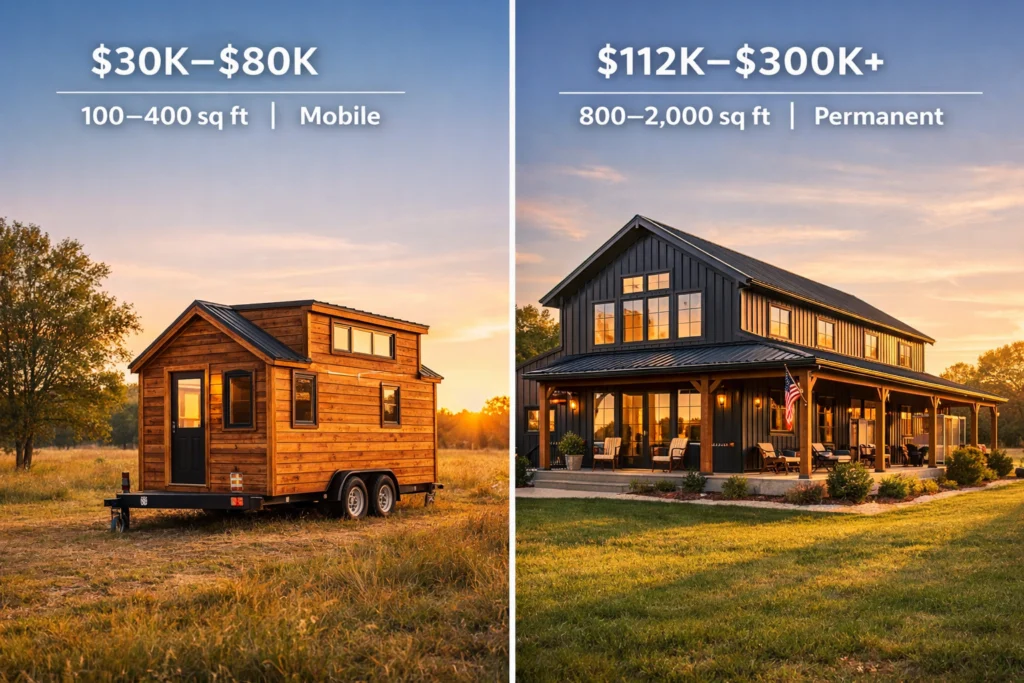
Here’s the counterintuitive truth: when you compare apples to apples (permanent foundation, code-compliant construction, utilities included), a small barndominium often gives you more space for your money than a tiny house.
A tiny house on a trailer might cost $45,000 but it’s also 200 square feet, legally can’t be parked most places, and won’t qualify for traditional financing. A small barndominium at $150,000 gets you 1,000–1,200 sq ft on your own land with a real address.
Tiny houses win on absolute sticker price and mobility. Barndominiums win on cost-per-square-foot, long-term value, and livability for anyone who needs more than a bedroom and a kitchenette. It depends entirely on your lifestyle, but if you have a family, work from home, or want a shop attached to your living space, the barndo almost always makes more financial sense.
| Category | Tiny House (on wheels) | Small Barndominium |
|---|---|---|
| Typical size | 100–400 sq ft | 800–2,000 sq ft |
| Typical total cost | $30,000–$80,000 | $112,800–$300,000+ |
| Cost per sq ft | $150–$300+ | $60–$160 |
| Traditional financing | Difficult to impossible | Challenging but possible |
| Resale value | Low / depreciates | Holds value in rural markets |
| Zoning & permits | Very restrictive | Easier in rural areas |
| Lifespan | 20–30 years | 50–150 years |
Bottom line: if the question is purely “what’s the cheapest roof over my head,” a used tiny house wins. If the question is “what’s the smartest investment for affordable, permanent rural living,” a small barndominium wins pretty handily.
How Big of a Barndominium Can I Build for $100,000?
Let’s be real: this is the question everyone’s actually asking. And the honest answer is it depends on how much of the work you’re willing to do yourself, and how “finished” your definition of “done” is.
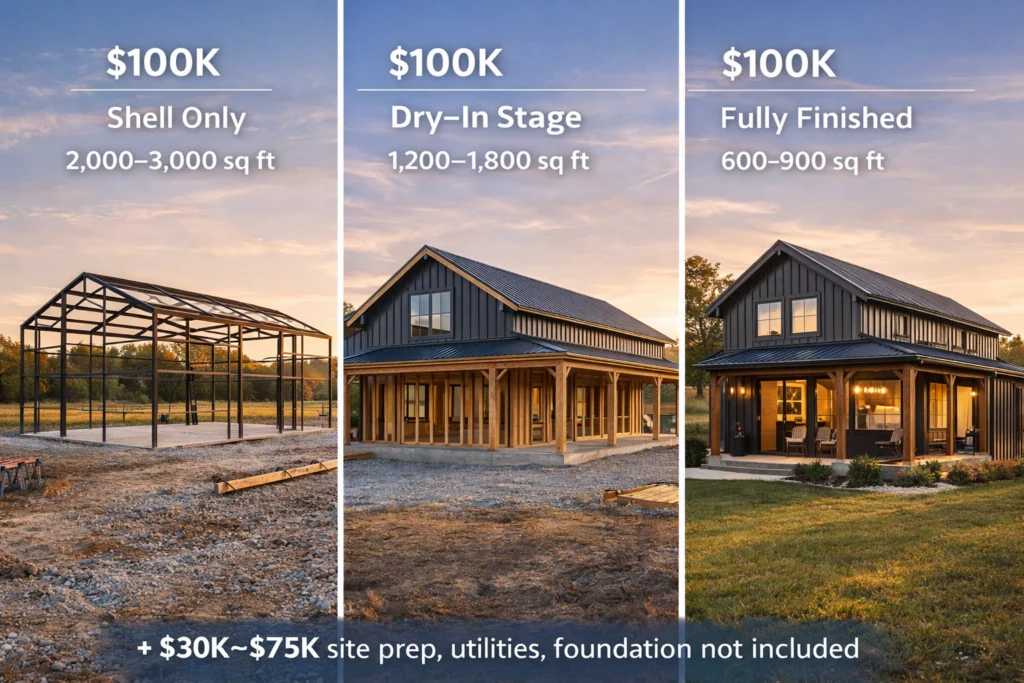
Here’s a practical breakdown of what $100,000 realistically gets you:
| Build approach | What $100K buys you | Approximate size |
|---|---|---|
| Shell/kit only (DIY assembly) | Exterior structure, roof, basic doors/windows | Up to 2,000–3,000 sq ft shell |
| Dry-in (exterior complete, interior blank) | Weathertight building, you finish the inside | 1,200–1,800 sq ft |
| Turnkey (fully finished, livable) | Move-in ready with plumbing, electrical, finishes | 600–900 sq ft |
The catch that most budget estimates conveniently skip? Land, site prep, foundation, septic, and utility hookups aren’t included in kit prices. These “invisible” costs can easily run $30,000–$75,000 before a single wall goes up, especially on raw rural land. That’s not a reason to give up on your dream; it’s just a reason to plan honestly.
Pro tip: If you’re working with a tight budget, building a smaller, fully finished barndo is almost always smarter than building a large shell you can’t afford to complete. A well-finished 800 sq ft home is infinitely more livable than a 2,000 sq ft uninsulated metal box.
The most expensive part of any barndominium, by the way, isn’t the metal building itself it’s the mechanical systems. Plumbing runs $7,000–$15,000. Electrical is $10,000–$30,000. HVAC adds another $6,000–$20,000. These costs are roughly the same whether your building is 800 sq ft or 2,000 sq ft, which is why small barndominiums have a higher cost-per-square-foot than larger ones. The fixed costs get spread across fewer square feet.
What Is the Smallest Size Barndominium?
Technically, you can build a barndominium as small as 400 square feet. Some people do. But there’s a difference between “technically possible” and “actually livable for more than a weekend.”
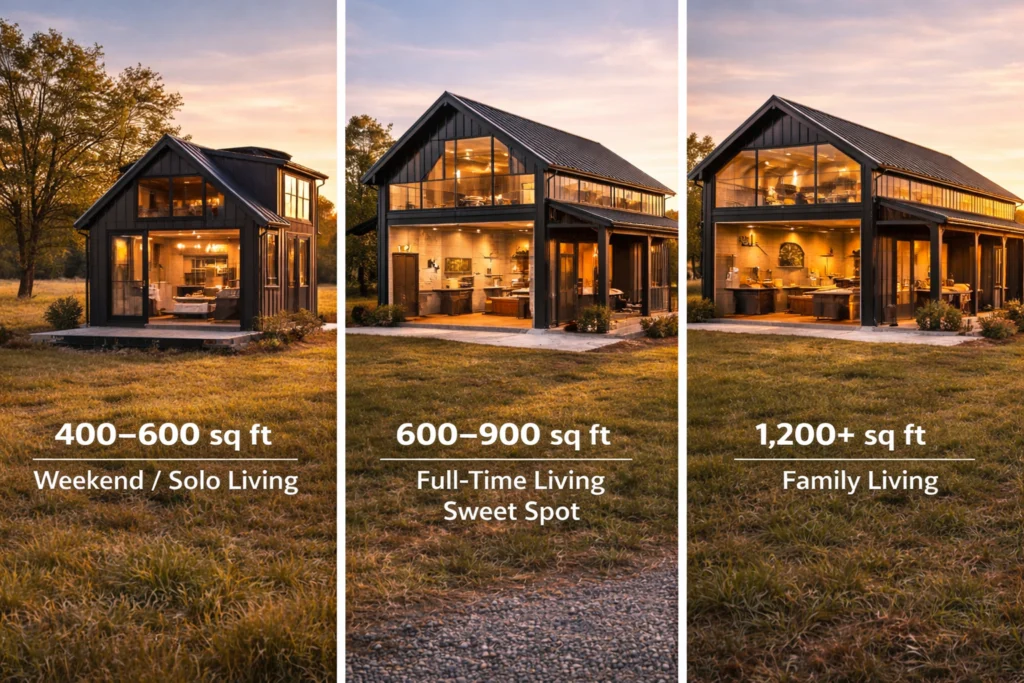
Here’s how to think about minimum sizes for different living situations:
- Solo living or vacation/weekend use: 400–600 sq ft works well. Think of it as a very well-designed studio cabin with a loft option.
- Couple or single person full-time: 600–900 sq ft is the sweet spot. You can have a proper bedroom, a real kitchen, and a small living area without feeling cramped.
- Small family (2–3 kids): You’re really looking at 1,200 sq ft minimum, ideally 1,500+ sq ft, so everyone has some breathing room.
- Home office + living combo: Budget for at least 1,000 sq ft, more if you need a dedicated workspace.
One of the reasons barndominiums feel bigger than their square footage suggests is the ceiling height. Most barndominiums have 12–16 foot ceilings, compared to the 8–9 foot ceilings in traditional homes. That volume makes a massive psychological difference. An 800 sq ft barndo with 14-foot ceilings and an open floor plan genuinely feels roomier than a 1,100 sq ft conventionally built home.
Here’s something important to understand about the “tiny house barndominium” concept that’s popular online: a tiny barndominium on a permanent foundation is a fundamentally different product than a tiny house on wheels. It’s built to code, sits on a slab, hooks up to utilities like a regular home, and can be financed and insured like one, too. The “tiny” just refers to the footprint not the quality or permanence.

- SPACIOUS & PRACTICAL: 12×16 FT storage shed, the large capacity easily stores large tools, lawn equipment, bikes, and ev…
- DURABLE & SECURE: The shed features a strong steel tube frame and rust-resistant galvanized steel panels for weather-res…
- WELL-VENTILATED & DRY: Outdoor shed integrated vents ensure optimal airflow to prevent dampness and stuffiness, design e…
What does a 2,000 sq ft barndominium look like?
A 2,000 sq ft barndominium is actually a very comfortable home for most families. At that size, you’re typically looking at 3 bedrooms, 2 bathrooms, an open-concept kitchen and living area, and quite possibly a mudroom or small workshop space. For reference, a 40×50 footprint gives you exactly 2,000 sq ft, which is a building roughly the size of a large two-car garage footprint, but with high ceilings and a thoughtful floor plan inside.
Can I Build a Barndominium for $200,000?
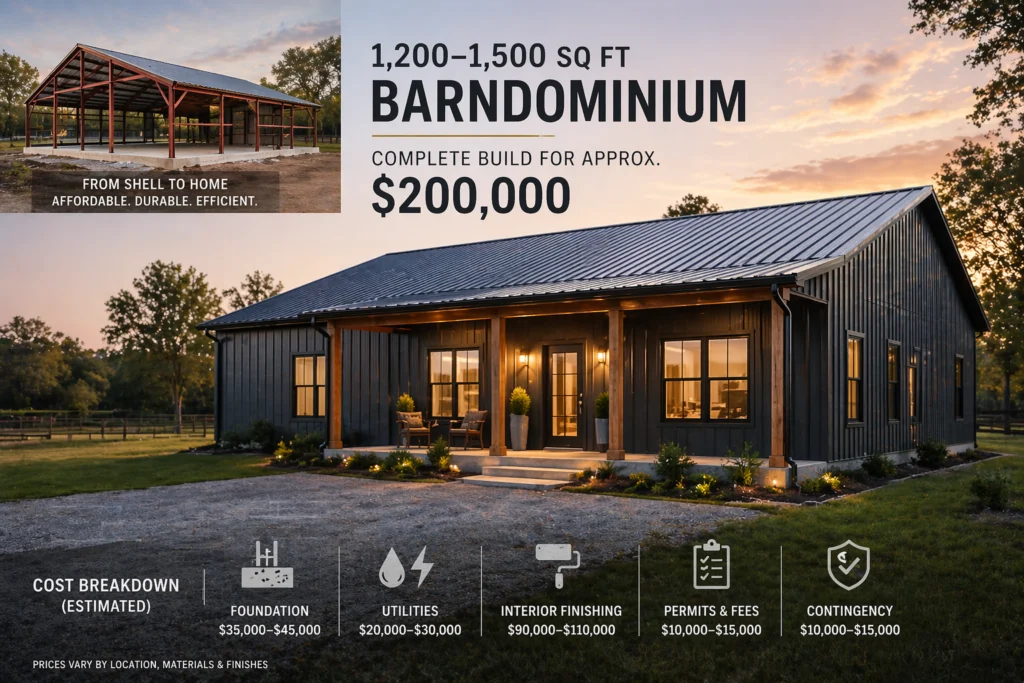
Yes, and $200,000 is actually a realistic budget for a genuinely comfortable small barndominium in most parts of the country. It’s not luxury money, but it’s enough to build something you’ll be proud of.
Here’s roughly what that budget looks like, all-in:
| Budget line item | Estimated cost |
|---|---|
| Barndominium kit (1,200–1,600 sq ft shell) | $36,000–$56,000 |
| Foundation (concrete slab) | $12,000–$22,000 |
| Site prep, grading, driveway | $10,000–$25,000 |
| Septic system | $5,000–$15,000 |
| Utility hookups (electric, water) | $5,000–$30,000 |
| Interior finishing (plumbing, electrical, HVAC, drywall, flooring) | $60,000–$90,000 |
| Permits & design plans | $3,000–$8,000 |
| 10–20% contingency buffer | $15,000–$30,000 |
Total: $146,000–$276,000. So $200,000 sits right in the middle of that range for a 1,200–1,500 sq ft fully livable home on a prepared lot. If utility hookups are cheap in your area (i.e., you’re near existing infrastructure), or if you do some of the interior work yourself, you can tip closer to the lower end. If your land is raw and remote, costs can push toward the top.
Location matters more than people realize. A barndominium in Oklahoma might run $110–$170/sq ft. The same build in Florida’s coastal areas can hit $150–$250/sq ft due to hurricane-rated materials and stricter codes. Get local quotes; national averages are a starting point, not a budget.
- Warm Reminder: This product offers a wide range of customizable configurations, layouts, and accessories hence price is …
- Prefabricated Modular System: Manufactured using factory-controlled production methods to ensure consistent quality and …
- Flexible Configuration Layout: The modular container design supports different layout arrangements and can be adjusted b…
Is it cheaper to build or buy a 2,000 sq ft house?
In most rural markets today, building a barndominium is still cheaper per square foot than purchasing an existing home. The average cost to build a traditional stick-built house runs $150–$400/sq ft, while a barndominium typically lands between $60–$160/sq ft. That said, “buy vs. build” math also has to account for land acquisition, your timeline, and the stress of managing a construction project. If you find a move-in-ready home at a fair price, sometimes that’s worth more than the savings on paper.
Why Do Banks Not Like Barndominiums?
Ah, here’s the part that trips up a lot of first-time barndo builders. You’ve got the land, you’ve got the plan, you’ve run the numbers, and then the bank says no.
It’s not that banks hate barndominiums. It’s that banks love comparables. When they’re underwriting a loan, they need to find similar properties that have recently sold nearby to establish the value of what you’re building. And in most counties, there just aren’t enough barndominium sales on record to give lenders a confident appraisal baseline. Fewer comparables = more risk in the lender’s eyes = harder to get a loan.
Here are your realistic financing options:
- Construction-to-permanent loans: These fund the build and then convert to a traditional mortgage. Some lenders are getting more comfortable with barndos, especially in states like Texas, Oklahoma, and Tennessee, where they’re more common.
- USDA loans: If you’re building in a rural area and meet income requirements, USDA construction loans can be an excellent option, and they’re more flexible about non-traditional home styles.
- Portfolio lenders: Local banks and credit unions that hold their own loans (rather than selling them to Fannie Mae or Freddie Mac) have more flexibility. These are often your best bet.
- Owner financing / seller financing: If you’re buying land from someone willing to carry the note, this can simplify the whole equation.
The honest advice: start your financing conversations early ideally before you buy land. Get a pre-approval in hand from a lender familiar with barndominiums before you commit to anything. This one step saves a lot of heartache down the road.

- Outdoor Living Space for Backyard Lounge Setup: Place sofas, dining sets, TVs, or hot tubs to transform your patio into …
- Dual-layer Mesh Screen & Tinted PC Panel System for Year-round Comfort: Fixed mesh screens provide continuous airflow an…
- Galvanized Steel Double Roof for Long-Hour Outdoor Comfort in Hot Weather: Improves airflow, reduces heat buildup, and p…
What Is the Lifespan of a Barndominium?
This question surprises people because the gut reaction is “it’s a metal building, will it last?” The answer is: longer than your traditional house, in most cases.
Well-built barndominiums routinely last 50–150 years. The metal shell is resistant to rot, mold, termites, and the kind of moisture damage that quietly destroys wood-framed homes over decades. Metal roofing typically lasts 40–50 years without major intervention; compare that to asphalt shingles that need replacing every 15–25 years.
The biggest longevity factors? Insulation quality, proper ventilation, and foundation integrity. Spray foam insulation (the preferred choice for most barndos) creates a tight thermal envelope and helps manage the condensation that can be an issue with metal buildings in humid climates. Get those three things right, and your barndominium will outlast you.
What Is the Cheapest Way to Build a Small Barndominium?
If budget is your primary constraint, here are the levers that actually move the needle:
1. Start with a kit, not a fully custom build
Prefab barndominium kits run $20–$50/sq ft for the shell and assembly, which is significantly less than custom construction. You sacrifice some flexibility in dimensions, but you gain speed, predictability, and lower labor costs.
2. Choose a simple, square, or rectangular footprint
Every notch, bump-out, and architectural flourish adds cost. A clean rectangle or square is the most cost-efficient shape. If you’re building 40×60, stick to 40×60; don’t add an L-shaped garage addition unless your budget can absorb it.
3. Keep it single-story
A one-story barndominium is cheaper to build than a two-story version of the same square footage. The structural engineering for multi-story metal buildings adds cost, and a single slab pour is simpler than dealing with a second-floor load-bearing system.
4. DIY the finish work
Painting, flooring installation, cabinet installation, and basic drywall finishing are all learnable skills. Doing this work yourself can realistically save $15,000–$30,000 on a 1,200 sq ft build. Leave the electrical, plumbing, and HVAC to licensed professionals; that’s not where you want to cut corners.
5. Build smaller and build it right
A 1,000 sq ft barndominium that’s fully finished, properly insulated, and comfortable to live in beats a 2,000 sq ft shell that sits half-finished for three years. Budget discipline early pays dividends for the rest of your life in that home.
How Much Does a 40×60 Barndominium Kit Cost?
A 40×60 footprint gives you 2,400 square feet, a popular size because it’s big enough to be a real family home while still being manageable to build.
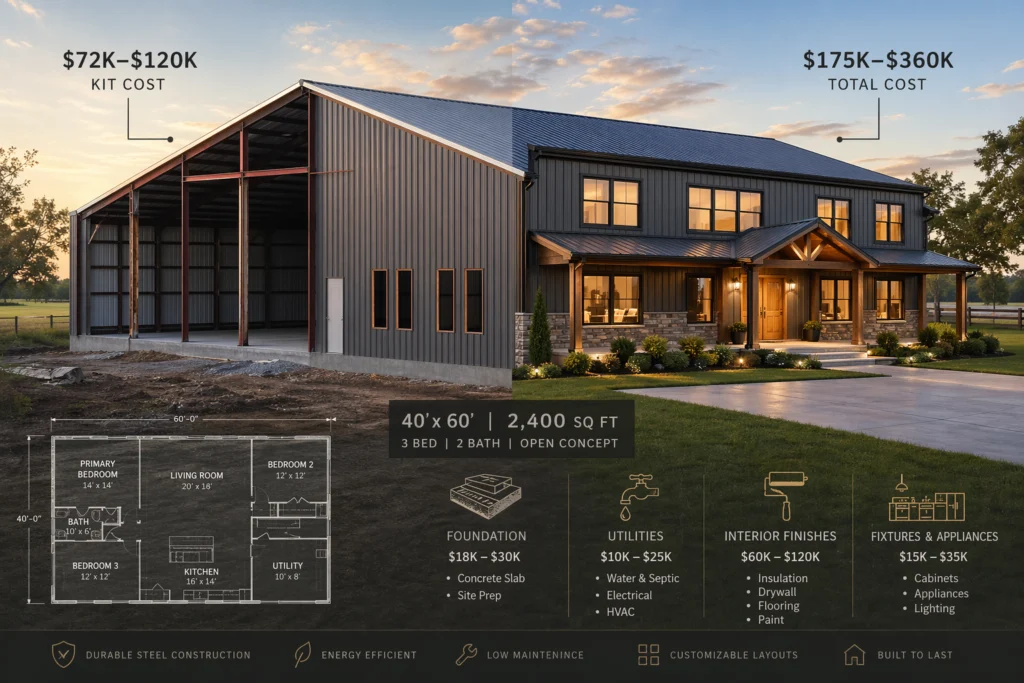
For the kit alone (materials and assembly of the exterior shell), expect to pay roughly $72,000–$120,000. That’s based on the $30–$50/sq ft kit pricing at 2,400 sq ft. Add site prep, foundation, interior finishes, utilities, and permits, and your all-in cost for a turnkey 40×60 barndominium will typically land between $175,000 and $360,000, depending on finish level and location.
Want to stay under $200,000 on a 40×60? It’s possible with budget finishes and some DIY labor, particularly in lower-cost states. Want a well-appointed, move-in-ready build? Budget closer to $250,000–$300,000 and you’ll be comfortable with the result.
In What States Are Barndominiums Illegal?
Barndominiums aren’t “illegal” anywhere per se, but zoning regulations in some areas effectively make them impossible to build. The key issue is residential zoning: in many suburban and urban zones, structures must meet specific construction standards (like requiring wood framing) that barndominiums don’t meet by default.
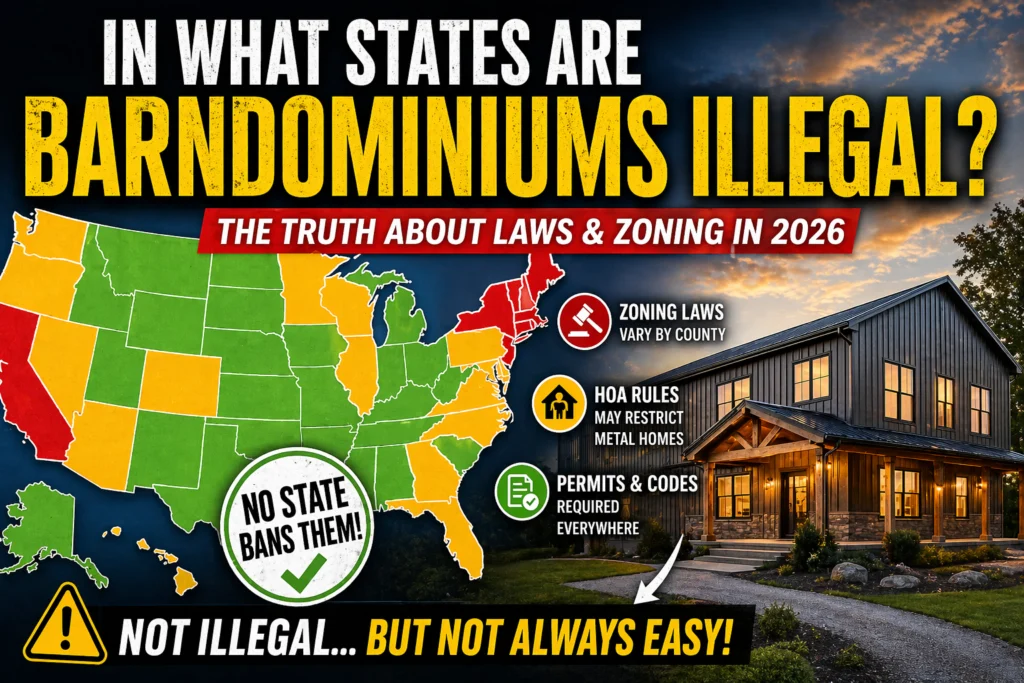
Where barndominiums thrive: rural counties in Texas, Oklahoma, Tennessee, Georgia, Missouri, Kentucky, and the Midwest generally. These areas have flexible zoning, plenty of open land, and established communities of barndo builders and contractors.
Where they’re tricky: dense suburban areas, HOA-governed communities, coastal zones with strict hurricane codes, and any county that defines “residential structure” in ways that exclude metal post-frame construction. Always always check with your county’s building and zoning department before purchasing land for a barndominium project.
The Bottom Line: Is a Small Barndominium Right for You?
Here’s the honest summary: a small barndominium is one of the most cost-effective ways to build a permanent, durable, custom home in rural America right now. It’s not a magic solution; you’ll still need to navigate financing, zoning, and the realities of construction project management. But if you go in with realistic numbers and a clear plan, you can build something genuinely special for far less than a conventional custom home would cost.
The people who succeed with barndominium builds share a few traits: they did their research before buying land, they got multiple contractor quotes, they built a budget with a 15–20% contingency, and they chose livable finished space over maximum square footage. Follow that playbook, and the barndo dream is absolutely achievable.
Ready to Start Planning Your Small Barndominium?
Before you buy land or sign anything, get at least three quotes from local barndominium builders. Costs vary significantly by region. Check USDA loan eligibility if you’re building in a rural area, and connect with a portfolio lender familiar with post-frame construction early in the process. Have questions about your specific situation? Drop them in the comments below, we read and respond to every one.

One Comment
Comments are closed.