The Ultimate Guide to Mobile Home Floor Plans (Single Wide, Double Wide, Specs)
For many, the dream of homeownership feels perpetually out of reach, a frustrating pursuit of space, comfort, and financial stability. Perhaps you’ve spent years in cramped apartments, longing for a quiet, private space that truly feels like yours, or a yard for your children or pets. This is where modern manufactured housing steps in. It’s not just about buying a house; it’s about claiming your piece of the American dream with a smart, affordable, and quality-built foundation.
Choosing the right mobile home floor plan is the single most important decision you’ll make, as it dictates your daily flow, your family’s comfort, and how you’ll live for years to come. Your home’s layout determines everything from the noise level in the master suite to the efficiency of your kitchen. This ultimate guide is here to simplify the process and show you how an intelligently designed layout can transform your life. Let’s find the perfect floor plan that finally feels like home.
Table of Contents
🔑 Understanding the Core: Single Wide vs. Double Wide Mobile Home Floor Plans
Before you select a single paint color or fixture, you must determine the fundamental size and shape of your home. This choice between a single-section and a multi-section unit will define the character and function of your entire living space. The right mobile home floor plan is a direct reflection of your lifestyle.
Single Wide Mobile Home Floor Plans: Efficiency and Affordability
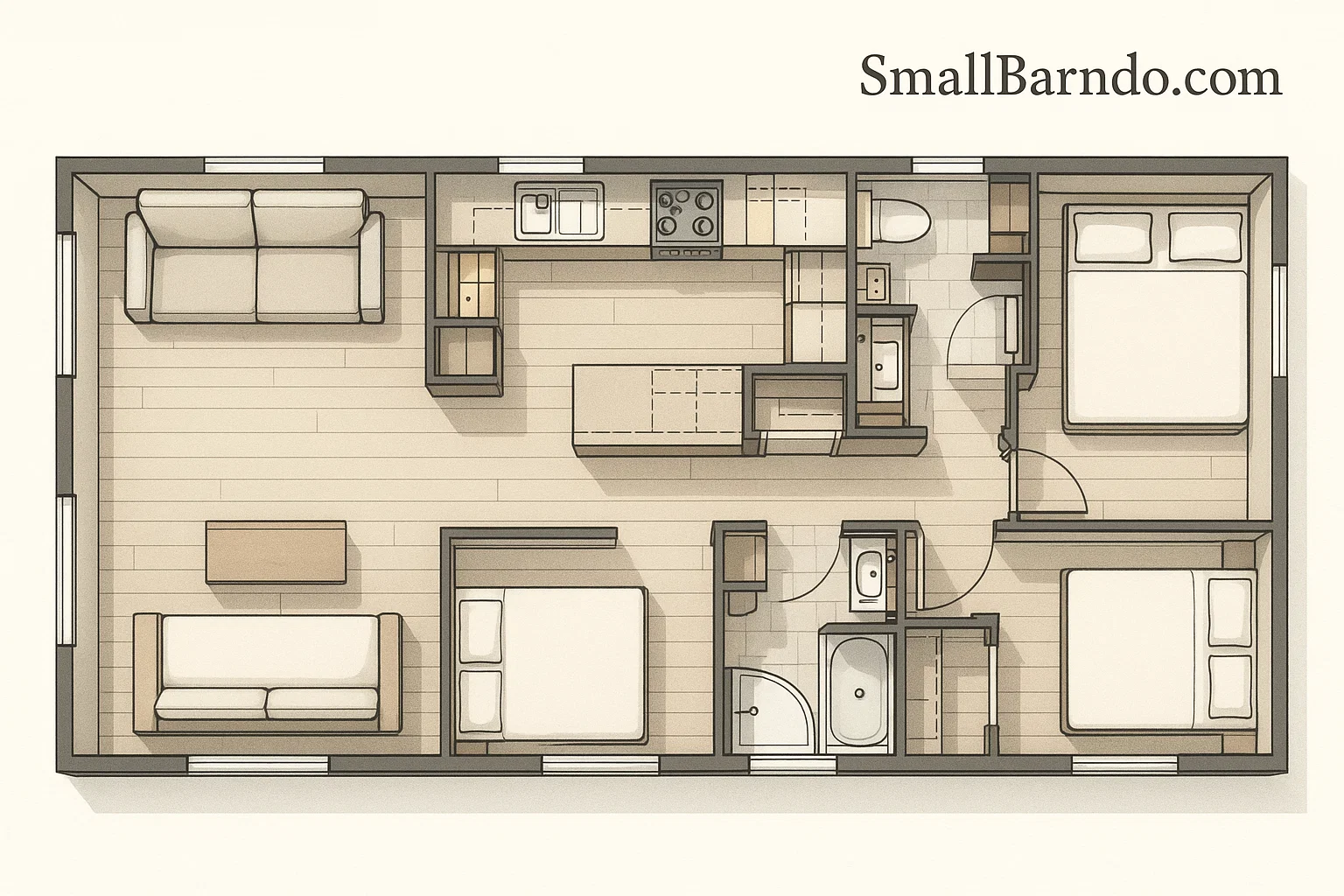
The single-wide home is built as one long, rectangular section and transported to your site as a complete unit. These homes are optimized for efficiency, affordability, and placement on smaller or narrower pieces of land. They are a powerful option for budget-conscious buyers and those seeking simplicity.
- Key Dimensions and Specs:
- Width: Typically $14$ to $18$ feet wide.
- Length: Ranges from $40$ to $90$ feet long.
- Square Footage: Generally falls between $500$ and $1,400$ square feet. A popular size, such as a $16 \times 76$ foot model, yields over $1,200$ square feet of living space.
- Layout and Design: The structure results in a linear, or “hallway style,” layout where rooms are arranged end-to-end. Modern single-wides often use open-concept living and dining areas to combat the perception of narrowness, maximizing the available natural light and usable space.
- Best For You If: You are an individual, a couple, or a small family with up to two children. You prioritize lower purchase and setup costs, or if your chosen lot has space constraints.
Double Wide Mobile Home Floor Plans: Space and Customization
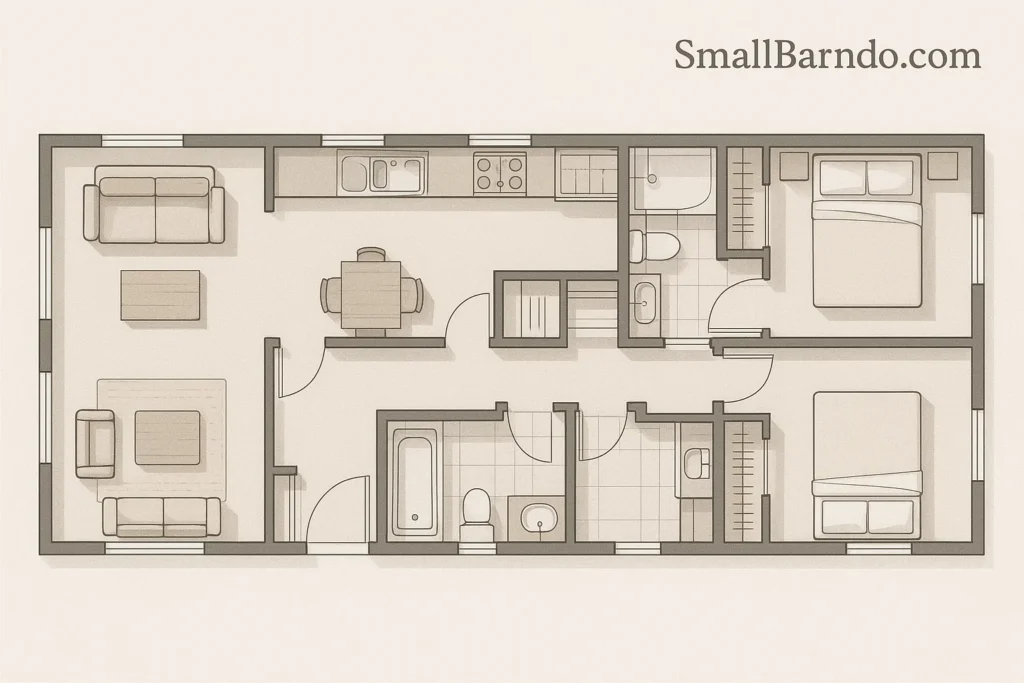
Double-wide homes are constructed in two separate, transportable sections, which are then joined together on-site. This structural difference offers a significantly wider footprint, allowing the home to closely resemble a conventional site-built house.
- Key Dimensions and Specs:
- Width: Usually $20$ to $32$ feet wide, and sometimes up to $36$ feet.
- Length: Ranges from $40$ to $90$ feet long.
- Square Footage: Typically runs from $1,000$ to $2,400+$ square feet, offering substantial living area.
- Layout and Design: The generous width allows for far more flexible layouts. You gain the space needed for features like a large, central kitchen island, separate formal dining areas, and a dedicated entryway (foyer). This width is also critical for implementing split bedroom mobile home floor plans.
- Condition/Exception: While the double-wide offers more space, you must factor in higher costs for complex transportation and on-site joining, as well as the necessity of a larger, level parcel of land for installation.
Comparison Table: Single Wide vs. Double Wide
Understanding the trade-offs is crucial for your final decision:
| Feature | Single Wide | Double Wide |
| Structure | One single section | Two sections joined on-site |
| Typical Width | $14′ – 18’$ | $20′ – 36’$ |
| Avg. Sq. Footage | $500 – 1,400$ sq. ft. | $1,000 – 2,400+$ sq. ft. |
| Average Cost (New, Delivered) | $\sim \$60,000 – \$90,000$ | $\sim \$120,000 – \$160,000$ |
| Setup Complexity | Easier and cheaper (one piece) | More complex and more expensive (two pieces) |
| Layout Feel | Linear, efficient, optimized for narrow space | Open, conventional, customizable, defined rooms |
📐 Key Mobile Home Floor Plan Specs and Design Considerations
A floor plan is more than just square footage; it’s the blueprint of your life. The specific arrangement of rooms, utilities, and architectural details will impact your comfort and flow every day.
The Importance of Room Configuration (Bed/Bath Count)
When reviewing mobile home floor plans, the bed and bath count is your starting point. You need a layout that not only accommodates your current household but also allows for the future growth or changing needs of your family.
- Single Wide Configurations: You will typically find $1$ to $3$ bedrooms and $1$ to $2$ bathrooms. The three-bedroom layout often involves slightly smaller secondary bedrooms to maximize the space available for living areas within the narrow footprint.
- Double Wide Configurations: These can easily accommodate $2$ to $5$ bedrooms and $2$ or more bathrooms. This size makes it feasible to include a true master suite and features like walk-in closets and large utility/laundry rooms.
- Critical Feature: Look for layouts with a dedicated utility room located near the kitchen or secondary exit. This provides necessary space for laundry, storage, and a buffer for outdoor noise.
Architectural Design: Open-Concept vs. Traditional Layouts
The division of your living space dictates how your family interacts and entertains.
- Open-Concept Floor Plans: This design minimizes interior walls, combining the kitchen, dining, and living areas into one large space.
- Pro: This style makes even a smaller home (especially a single wide) feel much larger, brighter, and more social. It’s ideal for entertaining and keeping an eye on children.
- Con: It offers less privacy and provides no physical barrier for noise from a cooking vent fan or loud TV can be heard throughout the main living space.
- Traditional Layouts: Rooms are clearly separated by walls and doorways. This is more common in larger double-wide and multi-section plans.
- Pro: Provides superior privacy, dampens sound transmission, and gives you distinct, multi-functional zones (e.g., a formal living room and a casual den).
Ceiling Height and Light: Specs that Matter
Modern manufactured housing has come a long way from the low, dark interiors of older “trailers.” Today, ceiling height is a major design focus.
- Up-to-Date Information: Most contemporary manufactured homes feature standard 8-foot ceilings, which match conventional construction standards.
- The Limitation: Federal and state transportation regulations cap the overall exterior height of a manufactured home section for safe transit (usually around $13’6”$ to $15’$). This imposes a structural limit on standard ceiling heights.
- The Upgrade: In premium double-wide mobile home floor plans, you can often select upgrades for vaulted, tray, or even 9-foot ceilings in the main living areas. This architectural trick significantly enhances the sense of space and luxury without requiring a physically taller home. Maximizing windows is also essential to draw light deep into the floor plan.
🏗️ Optimizing Flow: Split Bedrooms and Private Zoning
A key differentiator in quality mobile home floor plans is how they separate sleeping areas from common areas and from each other.
The Advantage of Split Bedroom Plans
A split bedroom plan is a layout design that separates the primary bedroom (master suite) from the secondary bedrooms using the main living areas (kitchen, living room) as a buffer.
- Enhanced Privacy: This configuration creates two distinct zones for sleeping. If you have teenagers, elderly relatives, or a need for a quiet home office, placing the master suite on one end of the home ensures maximum separation and sound control.
- Ideal for Guests: It allows guests to stay in a separate wing of the house, giving both them and you a higher degree of privacy.
- Availability: While standard in most double-wide mobile home floor plans, they are very rare, if not impossible, to achieve effectively in the narrow, linear structure of a single-wide home.
Customization and Future-Proofing
When selecting your floor plan, think beyond day one. You should look for plans that offer “flex” rooms or optional configurations.
- Flex Space: Can the dining room be easily converted into a home office? Can a small, secondary bedroom be repurposed as a study or craft room without disrupting the main flow?
- Kitchen Layout: Do you need an open peninsula (great for casual eating) or a true center island (best for serious cooking and storage)? The kitchen layout is the heart of any home, and in a mobile home, you often have the flexibility to select your preferred configuration.
🚧 Practical and Financial Angles: Land, Setup, and Resale
The best floor plan in the world is useless if you cannot legally place it on your land or afford the total installation cost. Your choice of single or double wide has major financial and logistical implications.
Land, Zoning, and Setbacks
Your lot dictates your options. You must verify local zoning laws before finalizing your floor plan choice.
- Lot Size Constraint: A larger double-wide home requires significantly more land for placement, not just because of its square footage, but because the two sections need space to be maneuvered, joined, and permanently set on the foundation.
- Zoning Restrictions (The Exception): Local regulations (zoning ordinances) can impose minimum requirements that exclude certain homes.
- Minimum Home Size: Some communities or subdivisions may require manufactured homes to have a minimum square footage (e.g., $1,100$ sq. ft.) to preserve neighborhood values, which may automatically rule out smaller single-wide homes.
- Width Restrictions: Historically, some areas restricted single-wide homes entirely, though modern laws often prevent this discrimination if the home meets specific aesthetic and safety criteria (e.g., having a pitched roof and permanent foundation).
- Setbacks: These are the minimum distances your home must be placed from property lines, streets, and other structures. A larger double-wide plan will require a correspondingly larger setback area, demanding a substantially bigger lot overall. Always check the required front, side, and rear setback specs with your local planning department.
The Cost-Benefit Analysis of Different Mobile Home Floor Plans
While single-wides are cheaper initially, a double-wide often offers a better long-term investment profile.
| Financial Angle | Single Wide | Double Wide |
| Initial Purchase Price | Significantly Lower ($\sim \$60k-\$90k$) | Higher ($\sim \$120k-\$160k$) |
| Price per Square Foot | Can be higher due to less economy of scale | Usually lower (more efficient use of materials) |
| Transportation & Setup | Lower cost ($2,000 – \$5,000$) | Higher cost ($4,000 – \$10,000$) |
| Resale Value Potential | Generally lower, less competitive with site-built homes | Generally higher, due to conventional appearance and size |
Appropriate Depth of Analysis: While manufactured homes, like traditional homes, are subject to local market conditions, the double-wide home typically holds its value better. Why? Its wider stance and more complex mobile home floor plans make it visually and functionally indistinguishable from many traditionally built houses, appealing to a wider pool of future buyers. For a higher long-term return on investment, the double-wide often provides the stronger argument.
❓ Frequently Asked Questions about Mobile Home Floor Plans
What is the biggest difference between single wide and double wide mobile home floor plans?
- Answer: The primary difference is the width and structure. Single-wides are one section ($14′-18’$ wide) with a linear, hallway-style layout. Double-wides are two sections joined on-site ($20′-36’$ wide) which allows for a much wider, more conventional room separation, central living areas, and the flexibility to incorporate features like large kitchen islands and split bedroom mobile home floor plans.
Do mobile home floor plans include customization options?
- Answer: Absolutely. Modern manufacturers offer significant customization, especially with double-wide plans. You can often choose from multiple room configurations (e.g., adding a fourth bedroom, converting a den), selecting interior finishes, upgrading kitchen islands, changing master bathroom layouts (e.g., adding a garden tub or dual vanities), and selecting exterior siding and roofing styles. You have extensive control over the final product.
What are “split bedroom” floor plans, and are they available in a single wide?
- Answer: A split bedroom plan places the master bedroom suite on one end of the home and the secondary bedrooms on the opposite end, using the living space as a privacy barrier. They are standard and highly sought after in double-wide homes because the necessary width accommodates them. They are much less common in single-wide plans because the linear, narrow structure prevents effective, private separation of the sleeping zones.
What specifications must I check before buying a mobile home floor plan?
- Answer: You must check three key specifications:
- Local Zoning & Setbacks: Ensure the home’s size is allowed in your area and that it fits on your lot while meeting all required distances from property lines.
- Foundation Type: Confirm the plan is compliant with local requirements for a permanent foundation (if required for financing/zoning).
- Delivery Access: Verify that the single piece (for single-wide) or the two pieces (for double-wide) can be safely and legally transported to your specific lot.
🎯 Conclusion: Choosing the Mobile Home Floor Plan That Fits Your Future
The decision between a single-wide and a double-wide mobile home floor plan is a personal one that boils down to a precise balance of three factors: Budget, Space, and Functionality. You must be honest with yourself about your family’s size and future needs. If affordability, simplicity, and low maintenance are your top priorities, the efficient single-wide is an excellent choice that offers incredible value. If you need room for a growing family, desire a conventional feel for long-term comfort, and seek a higher potential resale value, the double-wide will provide the space and flexibility you require.
Take the time to literally walk through example floor plans online or in person at a model center to visualize your daily life within the space. Imagine cooking in the kitchen, hosting guests, and enjoying a quiet evening in the master suite. When you meticulously match your lifestyle needs with the right specifications, you won’t just be buying a manufactured house; you’ll be building your perfect, affordable home.