Essential Barndominium Building Tips: How to Save $20k on Construction
The Dream of Space, Freedom, and Financial Independence
Imagine waking up in a home that breathes with you. You step out of a master suite that feels more like a high-end loft than a bedroom, walking across polished concrete floors that catch the morning light streaming through massive, industrial-style windows. Outside, the world is quiet. Inside, you have three thousand square feet of open-concept living, a vaulted ceiling that disappears into the shadows of exposed steel beams, and most importantly a mortgage that doesn’t make your stomach churn every time the first of the month rolls around.
For many of you, the barndominium isn’t just a Pinterest board or a passing architectural trend. It is a calculated rebellion against the suffocating costs of traditional 2026 housing. You’ve watched the “stick-built” market skyrocket, where a basic three-bedroom suburban home now carries a price tag that feels like a ransom note. You want something different. You want a sanctuary that reflects your personality, a space that can house your family, your hobbies, and your vehicles all under one massive, durable roof.
However, the path to building your “barndo” is paved with potential financial pitfalls. If you aren’t careful, the “affordable” alternative can quickly become a money pit. The good news? With the right strategy, you can claw back at least $20,000 from your construction budget without sacrificing the soul of your design. This isn’t about cutting corners; it’s about outsmarting the construction industry. Let’s walk through exactly how you can turn those savings into reality.
Table of Contents
1. Master the “Rectangular Rule” for Design Savings
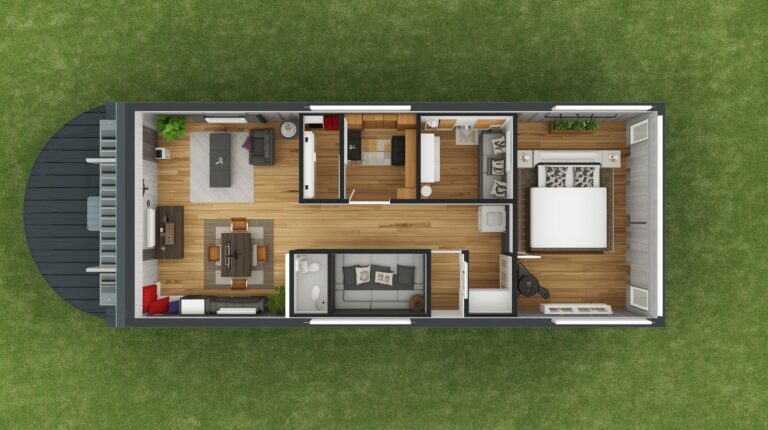
Your savings journey begins long before the first shovel hits the dirt. It starts on a piece of paper or, more likely, a digital floor plan. The architectural “bones” of your barndominium dictate the labor and material costs for the duration of the build.
Choose Stock Floor Plans Over Custom Architecture
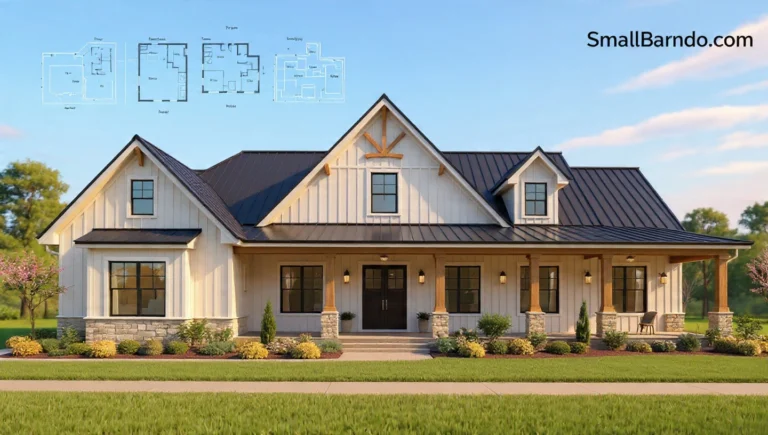
In 2026, the cost of a bespoke architect can be staggering. You might find yourself quoted anywhere from $4,500 to $8,000 for a fully custom set of blueprints. While the idea of a “one-of-a-kind” layout is tempting, the reality is that most of your needs can be met by high-quality stock plans.
When you buy a pre-designed plan, you are benefiting from designs that have already been vetted for structural integrity and building code compliance. These typically cost between $1,200 and $2,000. By making this one choice, you’ve already tucked $3,000 to $6,000 back into your pocket.
Pro-Tip: If you must have a custom touch, buy a stock plan that is “close enough” and hire a local drafter to make minor interior wall adjustments. This is significantly cheaper than starting from a blank canvas with a high-end firm.
The “Build Up, Not Out” Strategy
One of the most expensive mistakes you can make is designing a massive, sprawling single-story footprint. In the world of construction, the two most expensive components are the foundation and the roofing system.
Consider this comparison:
- Plan A: A 2,400 sq. ft. single-story ranch-style slab.
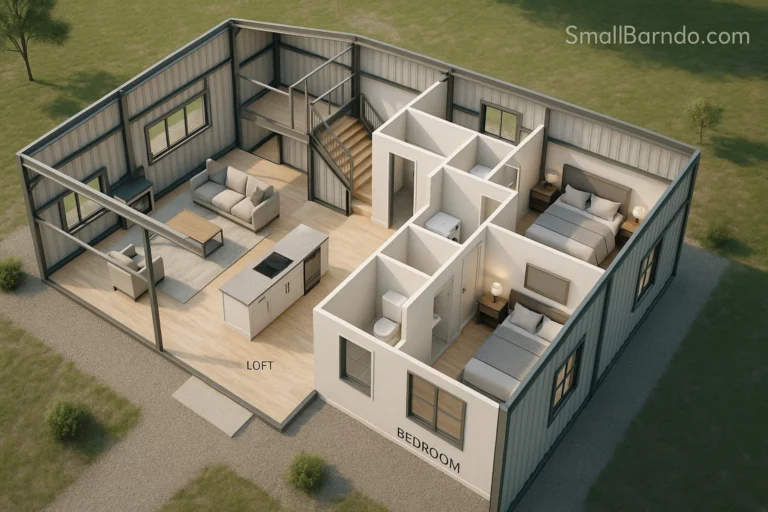
- Plan B: A 1,600 sq. ft. main floor with an 800 sq. ft. second-story loft.
Both offer the same living space, but Plan B requires a much smaller concrete slab and 33% less roofing material. By building “up” into the naturally high peaks of a steel building, you utilize space that is already being heated and cooled. This strategy alone can easily shave $5,000 off your foundation and framing costs.
Avoid “The Corner Tax”
Every time your exterior wall makes a turn, you pay for it. A simple four-corner rectangle is the pinnacle of barndo efficiency. Each “bump-out” or L-shaped wing requires:
- Complex foundation forms.
- Extra structural columns.
- Complicated roof valleys (which are prone to leaks).
- Increased labor hours for siding installation.
2. Leveraging Barndominium Kits vs. Custom Stick-Building
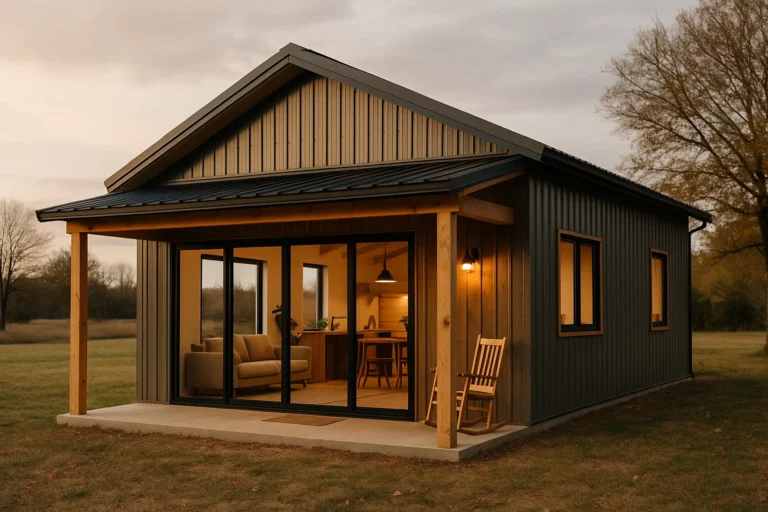
The “shell” of your home, the exterior walls and roof, is where you decide the fundamental DNA of your build. In 2026, you generally have two choices: a pre-engineered steel kit or a traditional wood-post frame (pole barn) style.
The Economic Advantage of Steel Shell Kits
Steel kits are the “Lego sets” of the construction world. Because these components are manufactured in a controlled factory environment and shipped to your site ready for assembly, the labor savings are immense.
Comparison: Steel Kit vs. Traditional Framing (2,000 sq. ft. shell)
| Feature | Metal Building Kit (Pre-Engineered) | Traditional Stick Frame / Wood Post |
| Average Shell Cost (2026) | $35,000 – $55,000 | $50,000 – $75,000 |
| Erection Time | 10–14 Days | 4–6 Weeks |
| Labor Costs | Lower (Bolt-together) | Higher (Skilled carpentry) |
| Long-term Value | Fire/Pest Resistant | Subject to Rot/Termites |
By opting for a kit, you can save roughly $7,000 to $10,000 in labor costs alone because the “heavy lifting” of measuring and cutting has already been done by a CNC machine at the factory.
Limitations of the Kit Approach
You need to be aware of the “Rigid Frame” limitation. Steel kits often use massive red-iron beams. While incredibly strong, these beams can be bulky and may interfere with where you want to place your interior windows or doors.
The Condition: Always check the shipping rates. In 2026, freight costs have stabilized but remain high. If your kit manufacturer is across the country, your $5,000 savings might be swallowed by the trucking company. Always look for a manufacturer within a 500-mile radius of your build site.
3. How to Save $10,000+ by Acting as Your Own General Contractor
This is the single most effective way to reach that $20,000 savings goal, but it isn’t for the faint of heart. When you hire a General Contractor (GC), you aren’t just paying for their expertise; you are paying a “management fee,” which typically ranges from 10% to 20% of the total project cost.
On a $250,000 barndominium build, a GC will take $25,000 to $50,000 as their profit and overhead. By stepping into this role yourself, you keep that money.
The “Owner-Builder” Reality Check
Acting as your own GC doesn’t mean you are the one pouring the concrete or wiring the outlets. Instead, you are the project manager. Your job is to:
- Vet and hire subcontractors (plumbers, electricians, drywallers).
- Pull the necessary permits from the county.
- Schedule deliveries so materials arrive exactly when needed.
- Ensure the site stays clean and safe.
The Risk: If a subcontractor doesn’t show up, it’s on you to find a replacement. If the building inspector finds a violation, you have to coordinate the fix. You are trading your time and stress for a massive financial reward.
Financing Challenges for Owner-Builders
In 2026, many major banks have tightened their “Owner-Builder” loan requirements. Federal programs like FHA or VA often require a licensed professional to oversee the project to protect the bank’s investment.
The Exception: If you have high equity in the land you’re building on, or if you’re working with a local credit union, they are often more flexible. Alternatively, you can hire a “Project Consultant,” a retired builder who charges a flat fee (say, $5,000) to sign off on your work and satisfy the bank, while you still do the legwork and save the other $20k.
4. Interior Finishes: Where the $20k is Won or Lost
The exterior of a barndo is relatively cheap. It’s the “insides” that break the bank. You can spend $10,000 on a kitchen or $100,000. To hit your savings target, you must be disciplined with your finishes.
Polished Concrete vs. Luxury Vinyl Plank (LVP)
Traditional flooring is a multi-step expense. You pay for the subfloor, the material (tile, hardwood, or LVP), and the labor to lay it. For a 2,000 sq. ft. home, LVP installation can cost you $10,000 to $16,000.
Instead, look at the slab you already paid for. By polishing and sealing your concrete foundation, you create a modern, “industrial-chic” look that is nearly indestructible.
- Cost of Polished Concrete: $3–$5 per sq. ft.
- Total for 2,000 sq. ft.: $6,000–$10,000.
- Immediate Saving: Roughly $6,000.
Ready-to-Assemble (RTA) Cabinets and “Remnant” Stone
The kitchen is the heart of the home, but it shouldn’t be the death of your budget. Custom cabinets in 2026 are averaging $18,000 for a standard-sized kitchen.
You can achieve the exact same aesthetic using high-end Ready-to-Assemble (RTA) cabinets. These are real plywood and hardwood cabinets that ship flat-packed. You spend a weekend with a drill and a friend putting them together, and you’ll likely only pay $7,000.
The “Remnant” Secret: When it comes to countertops, don’t buy a brand-new slab of quartz for your guest bathroom or your laundry room. Go to a local stone yard and ask for “remnants,” the leftover pieces from someone else’s massive kitchen project. You can often get premium stone for 50% off the retail price.
Interior Walls and “The Drywall Dilemma”
One of the unique features of a barndominium is the high ceiling. However, if you drywall all the way up to a 20-foot peak, your labor and material costs will skyrocket.
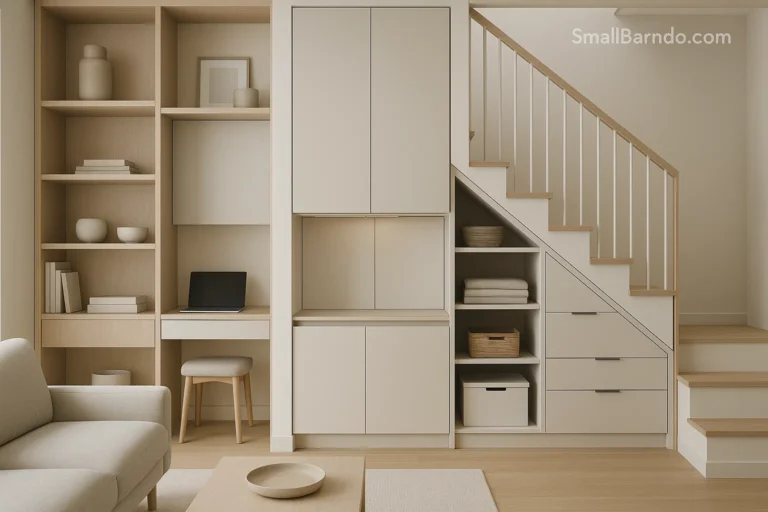
- Solution: Consider “dropping” the ceilings in bedrooms and bathrooms to a standard 9 feet. This creates a “mezzanine” feel, saves on drywall, and makes these smaller rooms much easier to heat and cool.
5. Navigating 2026 Financing and Hidden Land Costs
You could be the most efficient builder in the world, but if you pick the wrong piece of land, your $20,000 in savings will vanish into a hole in the ground literally.
Site Selection and Utility Proximity
In 2026, the cost of infrastructure is at an all-time high. When you are looking at land for your barndominium, “cheap” land often comes with a hidden tax.
- The Power Trap: If your building site is more than 200 feet from the nearest power pole, the utility company might charge you $15 to $30 per linear foot to run lines.
- The Septic Situation: Always ensure your land is “perked” (tested for drainage) before buying. A standard septic system might cost $8,000, but an “engineered” system for poor soil can easily cost $25,000.
By choosing a lot that is already “build-ready” with utilities at the road, you protect your budget from these five-figure surprises.
Understanding 2026 Loan Limits
As of early 2026, the Federal Housing Finance Agency (FHFA) has set the baseline conforming loan limit for most of the U.S. at $832,750. While your barndo build likely won’t hit that ceiling, knowing the limit is important for your appraisal.
Banks look for “comparables” (comps) when valuing your home. Since barndominiums are unique, an appraiser might struggle to find a similar home nearby.
- Strategy: Provide the appraiser with a list of other metal-framed homes in the county. If your appraisal comes in low, you’ll be forced to cover the gap with cash, which effectively “erases” your construction savings.
Conclusion: Taking the First Step Toward Your Sanctuary
Building a barndominium is perhaps the most significant financial and creative undertaking of your life. It requires a rare blend of visionary dreaming and cold, hard pragmatism. By adhering to the “Rectangular Rule,” choosing a pre-engineered kit, managing your own subcontractors, and being smart about your interior finishes, you aren’t just saving $20,000; you are ensuring that your home remains an asset rather than a burden.
The 2026 housing market is tough, but it’s not unbeatable. You have the tools, the technology, and now the strategy to build a space that offers you the freedom you’ve been chasing. Don’t let the complexity of the process intimidate you. Take it one step at a time: find your land, pick your plan, and guard your budget with the tenacity of a homeowner who knows exactly what their dream is worth.
Frequently Asked Questions (FAQ)
Is it really cheaper to build a barndominium than a traditional house in 2026?
Generally, yes. On average, a barndominium costs between $100 and $150 per square foot to finish, whereas a traditional custom stick-built home is often $180 to $250+. The primary savings come from the speed of construction and the lower cost of the exterior shell.
What is the most expensive part of a barndominium build?
Aside from the land, the mechanical systems (HVAC, Plumbing, and Electrical) are the most expensive. Because barndos are often large, open spaces, you need a high-efficiency HVAC system and top-tier insulation (like closed-cell spray foam) to keep energy costs down. While spray foam is expensive upfront, it’s a “limitation” on your budget that pays for itself within five years.
Can I get a mortgage for a barndominium in 2026?
Yes, but you need to do your homework. Many national lenders now recognize the barndominium as a standard residential dwelling. The key is ensuring your builder (or you, as the GC) follows all local codes and that the home is permanently affixed to a foundation. “Farm Credit” institutions are often the most barndo-friendly lenders.
What are the main limitations of a steel barndominium?
The biggest limitation is cellular and Wi-Fi interference. Steel shells act like a Faraday cage, often blocking signals. You will need to budget roughly $500–$1,000 for a signal booster or a robust mesh Wi-Fi system with external antennas to ensure you stay connected.